
Finding a tailor isn’t difficult. Finding the right tailor takes a little effort, but the rewards can last for years.
One of the biggest mistakes men make is assuming that all tailors offer the same level of skill. Nothing could be further from the truth. Some are exceptional craftspeople who take enormous pride in their work. Others may perform basic alterations reasonably well but struggle with more complicated garments. There are also those who simply aren’t very good.
Your job isn’t to find someone who owns a sewing machine. It’s to find someone you trust with clothing you’ve worked hard to earn and carefully selected for your collection.
The good news is that doing a little homework before handing over your favorite pair of jeans or sport coat dramatically improves your chances of finding the right person.
If you happen to live in a metropolitan area, you may have ten or more alterations shops within fifteen minutes of home. If you live in a small town or rural community, you may discover that only one or two people perform alterations within a thirty-minute drive.
Neither situation should discourage you. If you have many shops to choose from, your challenge will be narrowing the list. If you only have one or two nearby, your challenge becomes determining whether one of them meets your standards or whether driving a little farther makes more sense.
Fortunately, the process is almost identical regardless of where you live. Your first task isn’t selecting a tailor. It’s building the most complete list of realistic possibilities you can.
Start With A Search
If you’ve never searched for a tailor before, don’t overthink it. Open your favorite search engine and type:
tailors 12345
Replace 12345 with your ZIP code. That simple search will usually display a map along with businesses that provide tailoring or clothing alterations near your home.
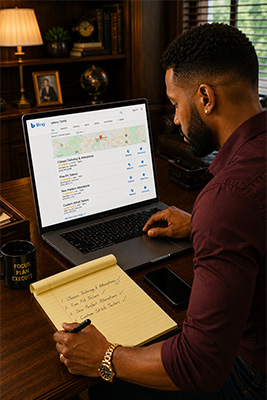 Write down every reasonable possibility within the distance you’re willing to travel. Don’t stop after the first few results, and don’t assume the business listed first is automatically the best one. At this stage, you’re simply trying to identify every realistic option before you begin judging any of them.
Once you’ve completed that search, perform the same search through the Yellow Pages. Different directories often contain different businesses, and relying on one search source may leave worthwhile candidates off your list.
 When I searched my own area, my search engine returned four possibilities. Running the same search through the Yellow Pages increased that list to eight. Had I relied on only one source, I would have missed half of the businesses available to me. That alone made the extra few minutes worthwhile.
There are also services such as Thumbtack and Angi that can help connect you with people who perform alterations. Those services may ask for considerably more information about you and your project before providing recommendations or estimates.
Personally, I don’t use them. I prefer contacting businesses directly rather than submitting my information through a third-party website, and I’m always cautious about where my email address may eventually end up.
Getting an estimate for clothing alterations through one of those services isn’t for me, but it could work perfectly well for you. The purpose of this search isn’t to force everyone to use the same method. It’s to make certain you’ve uncovered as many legitimate choices as reasonably possible.
Refining The List
Once your list is complete, resist the temptation to call the first business you recognize. Finding a tailor isn’t a race. The extra twenty or thirty minutes you spend researching today could save you from a disappointing alteration later.
Begin looking at each business individually. Read its reviews, visit its website if it has one, and pay attention to the type of work it appears to perform.
Does it primarily provide tailoring and alterations, or is sewing merely one of many unrelated services? Does it mention men’s clothing specifically? Does it show examples of completed work? Do customers repeatedly praise the workmanship, or do the reviews mention poor communication, missed deadlines, careless stitching, or clothing that still didn’t fit correctly?
One negative review doesn’t necessarily concern me. Several reviews describing the same problem certainly do. You’re looking for patterns, not isolated opinions.
Some businesses can be eliminated quickly because they simply don’t make sense for what you need. If a search result suggests that Linda’s Donut And Tailor Shoppe will glaze your pastry while shortening your trousers, you may want to keep moving.
Other decisions will require a little more judgment. A shop may have excellent reviews but specialize almost entirely in wedding gowns and formal dresses. That doesn’t automatically mean the person can’t alter men’s clothing, but it does mean you should ask before assuming.
A business with no website should not automatically be rejected either. Some excellent alterations professionals have operated for decades through local reputation and word of mouth. Their online presence may be nearly nonexistent while their work is outstanding.
The closest business isn’t automatically the best one, just as the business farther away isn’t automatically better. Convenience is useful, but competence matters more.
Work With The Choices You Have
If you live in a metropolitan area and still have six or eight promising candidates after your research, you have the luxury of being highly selective. You may eventually decide to use different tailors for different types of clothing, such as one for casual garments and another with more experience in suits or formal wear.
If you live in a rural area and only have one or two possibilities within thirty minutes, research each one carefully. Sometimes the local person turns out to be exceptional, and one excellent tailor is all you need.
If none of the nearby choices inspires confidence, consider expanding the search. A good tailor a little farther from home may be worth the drive, particularly if you save up several garments that need alterations before making the trip.
Having four or five items adjusted at once can make the extra travel far more worthwhile than driving that distance for a single pair of pants. It also allows you to make better use of your time without settling for work you don’t trust simply because it’s nearby.
By now, your list should look very different from the one you started with. You’ve gone from collecting names to identifying genuine possibilities.
The next step is where the internet stops being especially useful. It’s time to visit the finalists, look around their shops, ask a few questions, and decide whether you would trust them with your clothing.
Visit The Finalists
Once you’ve narrowed your list, visit each remaining business before handing over any clothing. You don’t need to arrive carrying a garment bag or expecting alterations that day. The purpose of the visit is simply to introduce yourself, ask a few questions, and get a feel for the person and the shop.
You can learn a surprising amount during a ten-minute conversation.
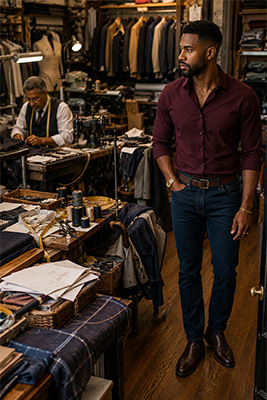
As you walk through the door, take a moment to look around before you begin talking. Are garments hanging neatly, or are they piled on chairs and stacked in corners? Does the workspace appear organized? Is the lighting good enough for someone to inspect fabric, stitching, and fit carefully? Do customers seem comfortable, and are they treated respectfully?
 ◄ View ►
A cluttered shop does not automatically mean the tailor lacks skill. Some outstanding craftspeople work in spaces that are far from glamorous. Still, clothing should be handled carefully, and the overall environment should leave you feeling reasonably confident that your garments will be protected and the work will be done with care.
◄ View ►
A cluttered shop does not automatically mean the tailor lacks skill. Some outstanding craftspeople work in spaces that are far from glamorous. Still, clothing should be handled carefully, and the overall environment should leave you feeling reasonably confident that your garments will be protected and the work will be done with care.
When you introduce yourself, tell them you’re looking for someone you may be able to use regularly. That simple statement gives the conversation a different tone. You’re not merely looking for the cheapest place to hem one pair of pants. You’re trying to determine whether this could become a dependable long-term business relationship.
You don’t need to arrive with a printed questionnaire. Ask a few simple questions and let the conversation develop naturally.
How long have you been doing alterations?
Do you tailor all kinds of men’s clothing?
Do you work on jeans, casual shirts, dress trousers, sport coats, and formal wear?
Are there certain garments or fabrics you prefer not to alter?
What is your usual turnaround time?
Can you show me examples of your work?
The answers matter, but so does the way they answer. Do they seem confident without being dismissive? Are they willing to explain what can and cannot be done? Do they ask what kinds of alterations you expect to need? Do they appear interested in earning your business, or do you feel as though you’re interrupting their afternoon?
You should leave each business with your questions answered and a general opinion about whether the person is likely to fit your needs.
Look For Attention To Detail
One question I would ask involves thread color, particularly if you plan to have jeans altered.
If you bring in jeans with orange stitching, ask whether the finished alterations will use the same shade of orange thread.
The answer should be yes, or at the very least that they will make every reasonable effort to match it closely.
Thread color is part of a garment’s design. If your jeans have orange stitching before they’re shortened or taken in near the thighs, there should still be orange stitching afterward. Not black, gray, white, or whatever color happened to be sitting in the machine. The same principle applies to gold, tan, navy, and other distinctive stitching colors.
Matching the original thread may seem like a small detail, but small details are often what separate careful workmanship from merely getting the job done.
When you ask, simply tell the tailor that you pay close attention to detail. You are not threatening to inspect every stitch with a magnifying glass. You are letting them know that you notice craftsmanship and appreciate work done properly.
A skilled professional will usually respect that.
In a metropolitan area, you may discover that different tailors have different strengths. One may be particularly good with suits and formal clothing, while another may have more experience with jeans, casual shirts, or leather. There is nothing wrong with using more than one tailor if your choices allow it.
In a smaller community, you may be trying to determine whether one person can handle most of what you own. Ask directly. A good tailor will be honest about the work they do well and the work they would rather not accept.
Start With Something Inexpensive
After settling on one or two promising candidates, test them with clothing you could replace without losing sleep.
Do not begin with your most expensive suit, your favorite leather jacket, or a garment that would be difficult to replace. Bring in an ordinary pair of jeans, a casual shirt, or an inexpensive pair of trousers that needs a relatively straightforward alteration.
This first job is not only a test of sewing ability. It gives you a chance to evaluate the entire experience.
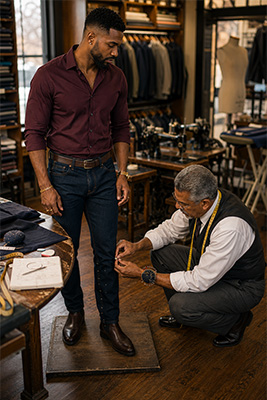 Pay attention to the fitting. Do they have you put the garment on? Do they pin and measure it carefully? Do they stand back and examine how it hangs? Do they ask how you like your clothes to fit, or do they simply make assumptions?
Measurements matter, but listening matters just as much. One man may want a stronger taper through the lower leg, while another prefers more room. One may like very little trouser break, while another wants a slight break over the shoe. A tailor cannot give you the result you want without understanding what that result is.
An experienced professional may also notice problems you have missed. They may point out excess fabric through the seat, uneven trouser legs, sleeves that do not hang correctly, or a shirt that pulls because of posture rather than size.
That is part of the value of hiring someone who knows the craft.
Before leaving the garment, make sure you both understand exactly what will be changed. Ask when it will be ready and what the work will cost. There should be no mystery about the plan.
Evaluate The Finished Work
When you return, try the garment on before leaving the shop whenever possible.
Do not simply hold it up, glance at the stitching, and assume everything is right. Wear it. Walk around. Sit down. Bend. Reach. Look at the garment from the front, side, and back.
Good tailoring should improve the way clothing looks without making it uncomfortable or difficult to move in.
Inspect the work carefully. Are the hems straight? Are both legs or sleeves the same length? Does the fabric hang naturally? Are there puckers, loose threads, uneven seams, or obvious signs that the garment was altered carelessly?
 ◄ View ►
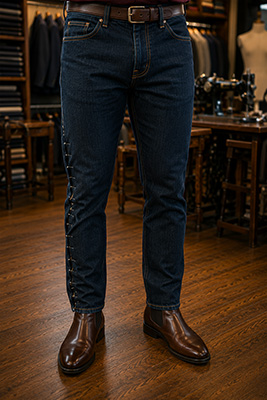
With jeans, look at the stitching. Does the thread match the original color? Does the new hem resemble the workmanship elsewhere on the garment? If the legs were tapered, do both sides appear balanced?
◄ View ►
With jeans, look at the stitching. Does the thread match the original color? Does the new hem resemble the workmanship elsewhere on the garment? If the legs were tapered, do both sides appear balanced?
Also consider the parts of the experience that have nothing to do with stitching. Was the garment ready when promised? Were you treated well? Did they remember what you asked for? If something needed a small correction, were they willing to make it without becoming defensive?
No one is perfect, and an occasional adjustment does not automatically mean the tailor did poor work. What matters is how the issue is handled.
After one or two inexpensive test garments, you should have a much better idea whether this person deserves your more valuable clothing. You will have seen how they measure, how they communicate, how closely they follow instructions, and whether the finished work meets your standards.
At that point, you are no longer choosing based on a website, a review, or a first impression.
You are choosing based on experience.
Choose The Tailor Who Fits Your Needs
After testing one or two candidates with inexpensive garments, you should have enough information to make a decision. The right tailor is not necessarily the one with the most impressive shop, the lowest prices, or the shortest turnaround time. It is the person whose work meets your standards, who listens to what you want, and who gives you confidence when you leave clothing in their hands.
If you live in a metropolitan area, you may decide that one tailor does not need to handle everything you own. Someone who performs excellent work on jeans and casual clothing may not be the person you choose for an expensive suit or formal jacket. Another tailor may specialize in leather, knitwear, or complicated alterations that require different equipment and experience.
There is nothing wrong with using different people for different classes of garments. You probably would not take a luxury automobile to someone who only repairs lawnmowers simply because both have engines. Clothing deserves the same common sense.
If you live in a smaller community, you may be fortunate enough to find one person who can handle nearly everything you wear. That can be extremely convenient, particularly as the tailor becomes familiar with your body, your preferences, and the way you like different garments to fit.
Over time, you may no longer need to explain that you prefer a stronger taper through the legs of your jeans or that you like your trousers with only a slight break. A good tailor remembers those details, and that familiarity can make every future visit easier.
Once someone has earned your trust, do not continue shopping around merely to save two or three dollars. Consistent workmanship and a professional who already understands your preferences can be worth far more than a slightly lower price somewhere else.
Build A Business Relationship
A great tailor should become more than the person who shortens your pants. The relationship can be similar to the one you develop with a trusted barber, mechanic, jeweler, caterer, or any other skilled professional whose work affects your life.
Be pleasant when you visit. Respect the tailor’s time, arrive when promised, explain what you need clearly, and pick up your clothing when it is ready. Pay promptly and compliment excellent work when the compliment is deserved.
None of that is complicated, but you may be surprised how many customers fail to do it.
People who work in service businesses are often treated as though their skills have little value. Customers talk down to them, arrive late, demand impossible deadlines, argue over every dollar, and then expect exceptional treatment in return.
That is not how lasting business relationships are built.
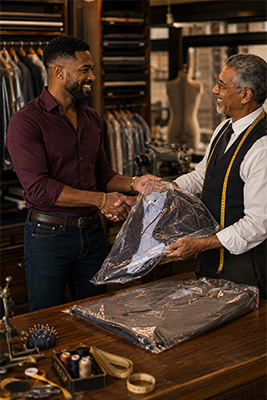 A tailor has spent years learning how garments are constructed, how fabrics behave, what can be changed, and what should be left alone. That knowledge deserves respect. You are not doing someone a favor by allowing them to alter your clothing. You are paying a skilled person to do something you probably cannot do yourself.
If you belong to a men’s group, social organization, business association, or simply know other men who occasionally need alterations, mention that you would be happy to recommend excellent work. Referrals can be extremely valuable to a small business.
Do not walk into a shop on your first visit and demand a discount because you might someday send someone through the door. Anyone can make that promise. Let the relationship develop first, and make genuine recommendations when the tailor has earned them.
If several people you recommend actually become customers, there is nothing wrong with mentioning it and asking whether the tailor might be willing to knock a couple of dollars off some of your future work.
You might say, “A few of the men I sent to you have become customers, and I’m glad they liked your work. Since I plan to continue using you regularly and recommending you, would you be willing to give me a small break on some of my alterations?”
Ask pleasantly, not as though you are presenting an invoice for every person you referred. The tailor may agree, may offer something different, or may not be in a position to reduce the price at all. Either way, accept the answer graciously.
The greater benefit may not be a discount.
It may be faster service when you need it, a small repair completed without charge, useful advice before you spend money on an alteration, or the willingness to fit you into an already busy schedule.
That kind of value usually grows from mutual respect, not aggressive bargaining.
Become The Customer They Want To Help
I have one woman I use almost exclusively for alterations, and I do a great deal of business with her. She knows I appreciate her work, I treat her with respect, and I do not expect every request to become an emergency simply because I failed to plan.
Occasionally, however, a genuine emergency does arise.
If I need something altered the same day for a social engagement that evening, I do not walk in and announce that she must rearrange her entire schedule for me. I explain the situation and ask whether there is any chance she can help.
I will say something like, “I know this is very short notice, but I have a social engagement this evening and really need this. If I throw you a couple of extra bucks, is there any chance you could have it ready today?”
Her answer is usually, “Of course, Doug. You’re a great customer of mine. Whatever you need.”
That is the kind of business relationship you are looking for.
She is not helping me because I bullied her, demanded special treatment, or threatened to take my business elsewhere. She helps because we have built a respectful relationship over time, and she knows I value both her work and the effort required to accommodate me.
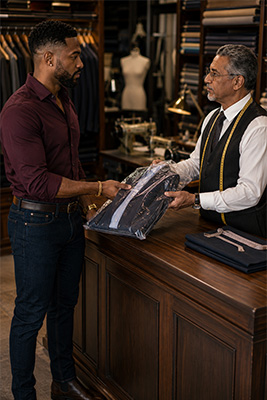 ◄ View ►
There is an important difference between expecting favors and becoming the kind of customer someone is genuinely happy to help.
◄ View ►
There is an important difference between expecting favors and becoming the kind of customer someone is genuinely happy to help.
A good customer does not abuse generosity. If a tailor squeezes in an emergency alteration, say thank you and offer to pay for the inconvenience. Do not suddenly begin treating every forgotten deadline as an emergency simply because the person helped once.
Trust works in both directions.
The Lesson Goes Beyond Tailoring
Everything we have discussed applies to more than the person who alters your clothes.
Mechanics, plumbers, electricians, caterers, barbers, jewelers, landscapers, cleaners, and countless other skilled tradespeople earn honest livings by providing services most of us need and cannot perform nearly as well ourselves.
Too many are mistreated by customers who look down on them simply because they work with their hands or provide a service. There is nothing admirable about treating another person as though his work makes him less important than you.
It is not sophisticated, powerful, or impressive.
It is simply inhumane.
Respect the people whose skills make your life easier. Learn their names. Listen when they offer professional advice. Pay them fairly and promptly. Compliment good work, recommend them when they deserve it, and remember that courtesy costs you nothing.
When people know their effort is appreciated, they often respond by doing more than the bare minimum. That should not be the only reason you treat them well, but it is one of the natural benefits of building relationships instead of completing anonymous transactions.
Finding the right tailor begins with a search engine and a ZIP code. It continues with research, a few shop visits, thoughtful questions, and one or two inexpensive test garments.
What you are ultimately looking for, however, is not merely someone who can operate a sewing machine.
You are looking for a skilled professional who listens, notices details, respects your clothing, and consistently delivers work you are proud to wear.
When you find that person, be the kind of customer worth keeping.
Do that, and you may gain much more than better-fitting clothes. You may build a professional relationship that serves both of you well for many years.