
 Shopping smarter doesn't mean always buying the least expensive option. It means knowing when to spend, when to walk away, and when a little patience can get you exactly what you want for considerably less.
We have more places to shop today than at any other point in history. A physical store may carry hundreds of shirts. An online search can put thousands of them in front of you within seconds.
That abundance sounds wonderful, and much of the time it is. It also gives us thousands of opportunities to make bad decisions.
Advertising follows us everywhere. Size labels seem to have lost whatever meaning they once had. Photographs don't always resemble the products that arrive. Return policies can make returning something nearly as expensive as keeping it. Even a store you have trusted for years can change direction and stop offering what attracted you in the first place.
Let's have a conversation about how to navigate all of that without removing every bit of pleasure from shopping.
Shopping should still be enjoyable. We simply need to become better at recognizing when we are making a smart decision and when somebody is successfully selling us a fantasy.
Advertising Hasn't Earned Your Money
Advertising has one job: move a product from your screen into your shopping cart. A smart shopper remembers that an advertisement is an invitation to investigate, not evidence that the product deserves to be purchased.
I learned that lesson through Gravité.
Because I was already using Particle skin care products, I gave the company more credibility than it had earned in the fragrance business. Then its Gravité commercials started appearing everywhere. Repetition created familiarity, and familiarity began feeling suspiciously like trust. I ordered a bottle without ever smelling it.
One spray ended the relationship.
Gravité may appeal to someone else, but it certainly didn't appeal to me. My private name for it became Eau de Turd. The bottle cost a little under one hundred dollars, which I now consider tuition for a useful shopping lesson.
An advertisement can put a product on my radar. It can encourage me to read about it, find independent opinions, request a sample, or look for it in a physical store. What it cannot do is make the final decision.
Photographs deserve the same skepticism.
 ◄ View ►
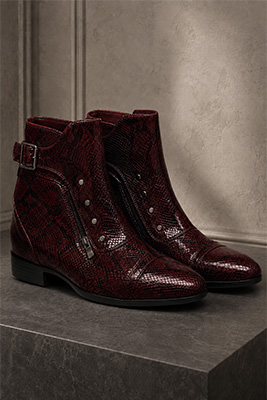
I once found a pair of snakeskin-style boots pictured in a rich, unusually dark burgundy. The color was distinctive, masculine, and the entire reason I ordered them. The boots that arrived were identical in style but fire-engine red.
◄ View ►
I once found a pair of snakeskin-style boots pictured in a rich, unusually dark burgundy. The color was distinctive, masculine, and the entire reason I ordered them. The boots that arrived were identical in style but fire-engine red.
The retailer had sold me its photograph, not its product.
When I asked to return the boots, the retailer didn't begin by correcting its mistake. It asked whether I would keep them for a 50% discount. When I refused, the proposed discount grew larger.
The discount was irrelevant. I didn't want fire-engine-red boots and wouldn't have been caught dead wearing them at any price. The company had advertised dark burgundy boots and sent me red ones. That was its error, not mine.
No matter how clearly I explained that, the company refused to pay the expensive return postage to China. Its escalating discount wasn't customer service. It was an attempt to make me keep an unwanted product so the seller could avoid responsibility for both the misleading photograph and the return cost.
Advertising isn't inherently dishonest, and attractive photography isn't automatically deceptive. Both are designed to present a product in its most desirable light. Your responsibility is to determine what remains after the lighting, language, repetition, and promises are stripped away.
Before buying, ask yourself whether you would still want the product if you had encountered it without the commercial. Can you sample it, examine it, or find independent photographs? What will it cost if the product that arrives doesn't match the promise?
Advertising can begin the conversation. It should never have the final word.
Let Stores Earn Your Trust
I am not suggesting that we approach every company as though it is trying to rob us. That would make shopping miserable.
 Trust stores, but make them earn that trust.
One online store I really like is Carbon2Cobalt. Yes, it is a pricey place to shop, but the company has earned my confidence through actual purchases.
If you generally wear a medium and order a medium from Carbon2Cobalt, it is probably going to fit. In my case, its shirts have fit so perfectly that they didn't require tailoring.
That is no small accomplishment. I have a barrel-shaped chest, and approximately half the shirts I buy, particularly button-up shirts, need some kind of alteration. When a company can send me a shirt that fits beautifully straight out of the package, I remember it.
Carbon2Cobalt's designs tend to be classic but still stylish. The company also loves texture, as do I. Its clothes reflect a personality that aligns with mine.
After buying my first shirt and seeing how well it fit, I stopped worrying very much about the return policy. Carbon2Cobalt had earned my trust by delivering exactly what I hoped it would deliver.
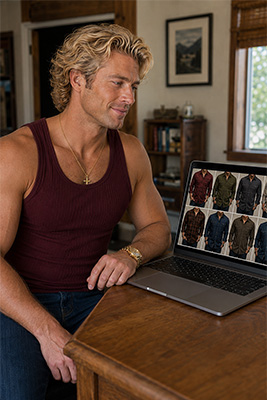
That doesn't mean I would tell you to place a thousand-dollar first order with an unfamiliar company. Make one controlled purchase. See how the sizing runs. Examine the quality. Pay attention to how closely the color and construction match the photographs.
 ◄ View ►
If that first purchase is successful, the store has earned the opportunity to sell you something else.
◄ View ►
If that first purchase is successful, the store has earned the opportunity to sell you something else.
Trust can also change.
Carbon2Cobalt has a related store called 32 Bar Blues. It offers the same excellent quality, and the clothes still fit me well. I once loved shopping there because its designs spoke directly to my taste.
Then the design direction changed.
There is nothing necessarily wrong with the current clothes. They simply don't attract me the way the earlier collections did. At this point, 32 Bar Blues and I are legally separated.
That could change again. A new collection or a different designer might bring us back together. Until then, I am not going to buy something merely because it comes from a store I once loved.
A store's personality can change, just as your style can change. Trusting the quality of a company doesn't obligate you to like everything it produces.
Read the Return Policy Before You Need It
Buying clothing online gives us something most physical stores cannot provide: variety.
 ◄ View ►
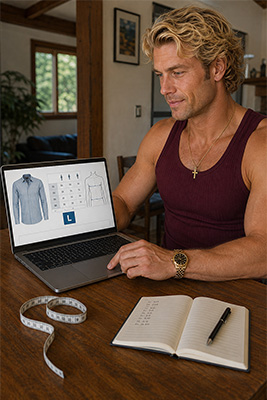
Garments made and sold by Chinese-based online stores can be a minefield. Even when a size chart is provided, the garment that arrives may bear little relationship to the measurements or familiar American sizing.
◄ View ►
Garments made and sold by Chinese-based online stores can be a minefield. Even when a size chart is provided, the garment that arrives may bear little relationship to the measurements or familiar American sizing.
I have ordered shirts marked large that I couldn't button around my body. As a fit man with approximately 12% body fat, I reasonably expected the shirts at least to come close to fitting. Instead, some seemed closer to an American extra small.
The boots completed the lesson. Technically, the store accepted returns. Practically, its refusal to pay the international postage made the policy nearly useless.
That is why you read a return policy before placing an order, not after opening the package.
Whenever possible, look for an online retailer offering free returns with prepaid postage. If an unfamiliar company requires you to ship unwanted merchandise back to China at your own expense, run away. If the return process involves a list of hoops designed to exhaust you into keeping the item, find another store.
Study the size chart too, but remember that a chart is only valuable when the company has measured its products accurately.
When you are uncertain about an unfamiliar retailer, buy one item. Don't order six shirts because the photographs are wonderful and the price looks irresistible. One successful purchase can earn another. One failure can save you from five additional mistakes.
Use Physical Stores and Online Shopping Together
Shopping online doesn't mean physical stores have become useless. The smartest approach is often to use both.
You would think a man could wrap a tape measure around his waist, write down the number, and buy pants in that size. That was what I was always taught, but clothing has changed over the decades of my existence.
Stretch fabrics can allow pants to accommodate a difference of an inch or two, but not every garment contains the same amount of stretch. A size that fits in one brand may be completely different in another.
Geez, it is 2026. Can't we have some sizing standards?
Apparently not.
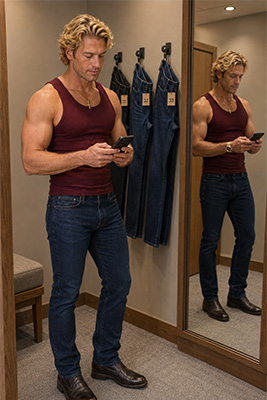 If you are shopping online without knowing how a particular brand fits, you may be shit out of luck. So what is a man supposed to do? He drags his ass to a physical store and tries on pants.
You probably already know which style of jeans you prefer. Try that style in every available brand. When you find the right fit, take out your phone and record the results.
Your notes might say:
Lee jeans: 29
Levi's: 31
George at Walmart: 28
The sizes do not need to agree. The fact that they don't agree is precisely why you are making the list.
Record more than the number. Include the brand, the style, and the fabric composition. A pair containing elastane may fit differently from rigid denim even when both carry the same size label.
Don't stop with jeans. Try on dress slacks and other pants you regularly wear. Yes, it requires some work, but that work pays off.
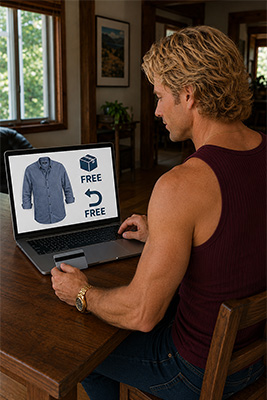
Once you know the exact brand, style, size, and material that fit you, compare prices online. The same garment may cost 10% to 40% less, and you can order it without guessing or creating a pile of returns.
 ◄ View ►
Whenever possible, find an online retailer offering free shipping and free returns, just in case the item proves to be the exception.
◄ View ►
Whenever possible, find an online retailer offering free shipping and free returns, just in case the item proves to be the exception.
Free shipping, however, is a preference rather than a commandment.
There is almost always an exception to every rule, and shipping costs are no different. Pay for shipping when it is the only thing standing between you and a shirt you absolutely must have.
The working rule is simple: free shipping most of the time; paid shipping once in a while.
Use some judgment with small independent stores. Spending an hour receiving personal service from a local merchant and then leaving to save eight dollars online isn't smart shopping. It is taking advantage of somebody's time and expertise.
Large national retailers and department stores are different. Their physical and online operations frequently work together, and many expect customers to compare prices across both.
The broader lesson is that a physical store and an online retailer are not necessarily competing worlds. Together, they can give you the information, selection, fit, and price that neither may provide alone.
Buy What Serves You
Shopping smarter isn't about always spending less.
 Sometimes the least expensive option is a terrible value. Sometimes an expensive shirt fits so perfectly and lasts so long that it becomes one of the smartest purchases you have made. Sometimes paying ten dollars for shipping is the only way to get the one item that makes you smile every time you wear it.
The goal is to understand what you are buying and why you are buying it.
Don't buy because a commercial appeared often enough to wear down your resistance. Don't keep buying from a store because it used to understand you. Don't trust a size label merely because the number looks familiar. Don't discover the return policy after the product disappoints you.
Let advertising introduce you to possibilities, but don't allow it to make the decision.
Let stores earn your trust, one purchase at a time.
Use physical stores to learn, online retailers to expand your choices, and your phone to create a record of what actually fits.
Then spend according to your style, your needs, and your budget.
After all, we all cut off the price tags. Nobody is going to pull down your collar to determine what your shirt cost or whether you paid for shipping. What people see is whether your clothes fit, whether they suit you, and whether you wear them with confidence.
That is shopping smarter.