
The finest fabric in the world is not fine for you if it costs too much, requires care you will never give it, or makes you uncomfortable every time you wear it.
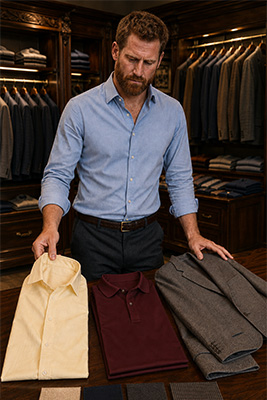 Fabric discussions have become unnecessarily pretentious. Listen to
enough influencers and you may come away believing that every worthwhile
shirt must be 100 percent cotton, every good sweater must be cashmere,
and anything containing a man-made fiber should be carried out of the
house with a pair of tongs.
Fabric discussions have become unnecessarily pretentious. Listen to
enough influencers and you may come away believing that every worthwhile
shirt must be 100 percent cotton, every good sweater must be cashmere,
and anything containing a man-made fiber should be carried out of the
house with a pair of tongs.
That is nonsense.
Natural fibers can be wonderful. Cotton, linen, silk, wool, and cashmere each have qualities that have kept them desirable for generations. Modern synthetic fibers and blended fabrics can also be wonderful. They may resist wrinkles, hold their shape, stretch with your body, dry more quickly, cost less, and require far less attention.
The intelligent question is not, “Is this fabric natural?” It is, “Will this fabric serve me well?”
Let's explore how to answer that.
Begin With Your Actual Life
A fabric does not live on a label. It lives on your body and eventually enters your laundry room.
Before admiring a fiber name, think about how you will use the garment. Will you wear it for a full workday, an evening out, a few hours at dinner, or while traveling? Do you run warm? Will the garment need frequent washing? Are you willing to iron it? Will you take it to a dry cleaner? Does pet hair cling to it? Will it still look presentable after sitting in a car for an hour?
There is no universally perfect fabric because men do not live identical lives. A beautiful linen shirt may be ideal for a summer dinner if you appreciate its relaxed wrinkles. It may drive you insane if you expect it to remain crisp from morning until night. A wool sport coat may provide beautiful structure and drape, but that does not make it the right choice for a man who overheats easily.
Your habits matter as much as the fabric's reputation.
This is where a great deal of expensive advice fails. It tells you what you are supposed to appreciate without asking whether you will enjoy owning it.
Natural Does Not Automatically Mean Better
 ◄ View ►
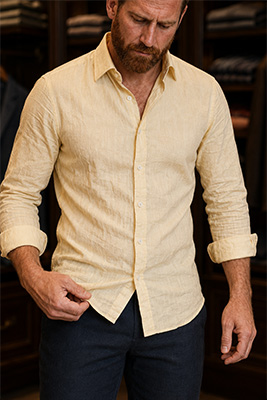
Natural fibers have genuine strengths. Cotton can feel familiar and
comfortable. Linen can be cool and visually distinctive. Wool can
provide warmth, structure, and resilience. Silk can offer softness,
color depth, and a beautiful surface.
◄ View ►
Natural fibers have genuine strengths. Cotton can feel familiar and
comfortable. Linen can be cool and visually distinctive. Wool can
provide warmth, structure, and resilience. Silk can offer softness,
color depth, and a beautiful surface.
None of that makes every garment made from those fibers excellent.
A poorly constructed cotton shirt is still a poorly constructed shirt. Low-quality wool can feel rough. Linen wrinkles because that is part of its nature, whether or not an influencer describes those wrinkles as charming. Silk may require more careful handling than a man wants to provide.
Fiber content cannot tell you everything about quality. The grade of the raw material matters. So do the weave or knit, fabric weight, finishing, stitching, construction, dye, and how the finished garment fits.
A label reading “100% cotton” is a fact, not a guarantee.
Natural also does not mean free from processing. Fibers must still be cleaned, spun, woven or knitted, dyed, finished, cut, and assembled before they become the shirt hanging in front of you. We should stop treating the word natural as though it possesses magical powers.
Modern Blends May Be the Smarter Choice
Some men hear “blend” and immediately assume compromise. I often see improvement.
A manufacturer may combine fibers to preserve the qualities we enjoy while reducing the qualities we do not. Cotton blended with a small amount of elastane can retain the familiar feel of cotton while allowing the garment to move with the body. Wool blended with a durable synthetic fiber may become easier to care for and better able to withstand regular wear. A shirt incorporating polyester may resist wrinkles and hold its color and shape longer.
Those are not insignificant advantages.
Who wants to stand over an ironing board every time he washes a casual shirt? I do not mind ironing occasionally, but most men do not want every garment they own to become another household assignment. If a blend comes out of the dryer looking presentable, keeps its shape, and remains attractive after repeated wear, it may be the more intelligent purchase.
I’m allergic to ironing. Wrinkle-free garments are medically necessary.
Blends can also improve comfort. A little stretch across the shoulders may prevent a shirt from pulling when you reach forward. Flexibility through the waistband and seat can make pants more comfortable when you sit. Shape recovery helps a garment return to its original form rather than remaining stretched at the knees, elbows, or backside.
The blend itself is not proof of quality either. Percentages matter, construction matters, and the finished garment still needs to be judged. The point is that a blend deserves evaluation, not automatic rejection.
Stretch Changed My Mind
 ◄ View ►
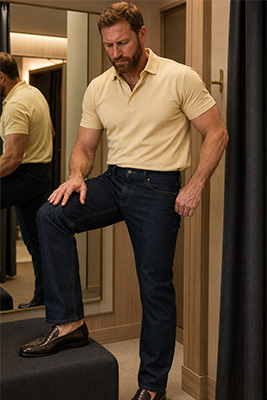
When stretch jeans first appeared, I scoffed. How dare they muck up
something I had been wearing all my life by making it stretch?
◄ View ►
When stretch jeans first appeared, I scoffed. How dare they muck up
something I had been wearing all my life by making it stretch?
Us older guys can become a little too committed to old thinking. Fortunately, I am extremely curious.
While trying on jeans during a period of weight loss, I noticed a rack advertising stretch denim. I had extra time, so I tried a pair. The size I expected fit well. Then a smaller size fit. I tried another size down and discovered that it fit too.
I stood there smiling and finally chuckled. This old dog had learned a new trick.
The lesson was larger than the number on the label. Stretch allowed the jeans to follow my body more comfortably and gave me options I would have dismissed without trying them. It also reminded me that fabric technology changes, and refusing to investigate it only limits my options.
Stretch is not permission to squeeze yourself into pants two sizes too small. The mirror still gets a vote. Fabric should move with your body without pulling, shining from strain, or displaying every detail you would prefer to keep private.
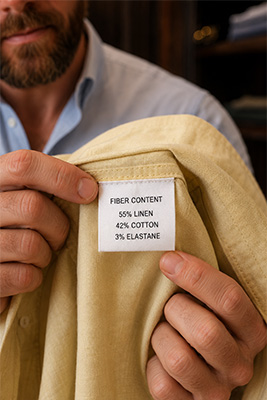
Read the label and look for fibers such as elastane or spandex. Even a small percentage can noticeably affect movement and fit. Then try the garment because percentages on a tag cannot tell you exactly how the finished fabric will behave.
There Is No Shame in Man-Made Material
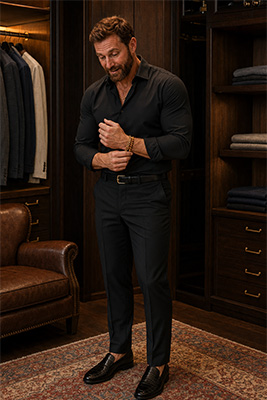 Influencers would sometimes have you believe they would not be caught
dead in an artificial or petroleum-based material. That position becomes
much easier to maintain when someone else is paying for the clothing,
doing the laundry, ironing the clothes, and dropping off and picking up
the dry cleaning, or when selling expensive merchandise is part of the
business.
Influencers would sometimes have you believe they would not be caught
dead in an artificial or petroleum-based material. That position becomes
much easier to maintain when someone else is paying for the clothing,
doing the laundry, ironing the clothes, and dropping off and picking up
the dry cleaning, or when selling expensive merchandise is part of the
business.
If your budget leads you toward synthetic fabrics, give it no shame whatsoever.
If you are clean, wearing attractive clothes that fit, adding a little jewelry, grooming yourself properly, and smelling good, you have every bit as much right to feel confident as the man wearing $1,000 boots, $500 jeans, and an $800 shirt.
Remember this: we all cut off the price tags.
No one at dinner is going to pull down your collar to discover whether your shirt is rayon rather than silk. Most people will never know what you spent or what percentage of polyester appears on the care label. They will see the complete man standing in front of them.
They will notice whether the color flatters you, whether the clothing fits, whether you look comfortable, and whether you carry yourself with confidence. If you do it correctly, they will see a well-put-together man. Your budget is none of their damn business.
Synthetic fibers do have tradeoffs. Some may retain heat or odor more readily. Some can cling, develop static, pill (form small balls of tangled fiber on the surface), or create a shine that looks less refined. Others perform beautifully. Once again, the answer is not worship or rejection. Touch the fabric. Try it on. Look at it under good light. Move in it. Read the care instructions. Judge the garment in front of you.
Read Both Labels Before You Buy
 ◄ View ►
Most clothing gives you two useful pieces of information: what the
garment is made from and how the manufacturer expects you to care for
it.
◄ View ►
Most clothing gives you two useful pieces of information: what the
garment is made from and how the manufacturer expects you to care for
it.
The fiber label tells you the composition. The care label tells you what ownership may require.
A garment may look like a bargain until you discover that it requires dry cleaning after every few wearings. A delicate fabric may demand hand washing, reshaping, and drying flat. A shirt may tolerate the washing machine but not the dryer. Those requirements are not necessarily bad, but they belong in the purchasing decision.
Be honest with yourself. If you know you will eventually throw everything into the washer and dryer, do not buy clothing that depends on a completely different lifestyle. You are not purchasing only the garment. You are accepting its maintenance agreement.
When shopping online, enlarge the label photographs when available and read the written fabric and care information. If the retailer provides neither, ask before purchasing or decide whether the uncertainty is worth the risk.
Once you find a garment that performs especially well, photograph its labels. That information can guide future purchases. You may discover that your favorite travel shirt contains a particular blend or that the pants retaining their shape all include a small amount of elastane.
Your closet can teach you which fabrics work for you if you pay attention to the evidence already hanging there.
My Complicated Relationship With Cashmere
 As the decades fly by, I find myself becoming more cynical and
skeptical. My feelings about cashmere provide a perfect example.
As the decades fly by, I find myself becoming more cynical and
skeptical. My feelings about cashmere provide a perfect example.
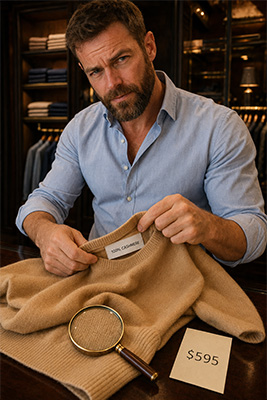
I appreciate a beautiful cashmere pullover. Cashmere can be remarkably soft, and a well-made garment can feel luxurious against the skin. My problem is not with the fiber. My problem is knowing exactly what I am buying and whether the price reflects the garment or the marketing surrounding it.
The word cashmere carries enormous prestige, and prestige creates opportunities for exaggerated claims, questionable blends, confusing labels, and prices that may have more to do with perception than performance. A high price by itself does not prove purity or quality.
I have long believed that aggressive softening treatments can make ordinary wool feel so smooth that many buyers could be fooled by touch alone. I once joked that someone could put a common wool sweater in a dryer with 15 sheets of unscented fabric softener for four hours and produce something soft enough to fool people. That is my skeptical illustration, not laundering advice, and I have no intention of sacrificing a sweater to prove it.
The serious point remains: softness alone cannot establish authenticity.
Unless you are prepared to seek specialized fiber testing, most of us ultimately depend on labeling, the reputation of the manufacturer and retailer, construction quality, and our own judgment. That does not mean you should never purchase cashmere. It means the word should not suspend your skepticism.
Buy it because you love the garment, trust the seller, accept the care requirements, and believe the pleasure it gives you justifies the price. Do not buy it merely because cashmere is supposed to impress you.
Judge Performance After Ownership
 ◄ View ►
The fitting room tells you how a fabric feels for ten minutes.
Ownership tells you the truth.
◄ View ►
The fitting room tells you how a fabric feels for ten minutes.
Ownership tells you the truth.
Notice what happens after several hours of wear. Does the garment breathe? Does it begin to itch? Does it stretch and recover? Does it wrinkle attractively, wrinkle terribly, or barely wrinkle at all? Does the color remain rich after washing? Do the seams twist? Does the surface pill? Does it attract every piece of lint within a 20-mile radius?
Then consider how often you choose to wear it.
A supposedly superior garment that remains untouched because it is uncomfortable or difficult to maintain is poor value. An inexpensive blended shirt that flatters you, washes easily, resists wrinkles, and becomes part of your regular rotation may be one of the smartest purchases you make.
Cost per wear matters more than prestige per label.
This is also why you should not decide whether you love or hate an entire fiber based on one garment. Construction and finishing vary enormously. One polyester shirt may feel unpleasant while another performs beautifully. One wool sweater may itch while another feels comfortable. Let each garment present its own case.
Let the Fabric Work for You
Fabric should support your appearance, comfort, budget, and life. It should not become another status test designed to make you feel inadequate.
Natural fibers deserve appreciation, not worship. Synthetic fibers deserve evaluation, not embarrassment. Modern blends often provide an excellent balance of appearance, movement, durability, care, and price. Labels provide useful information, but the mirror, your body, and your experience provide the final verdict.
Choose clothing because it flatters you and performs the job you bought it to perform. Care for it as required, remember what works, and remain curious enough to reconsider old assumptions when fabric technology offers something better.
The best fabric is not necessarily the most natural, expensive, prestigious, or heavily promoted.
The best fabric is the one that serves you beautifully.