
Let’s have a blunt conversation about shirts because the shirt usually speaks before the man wearing it ever opens his mouth.
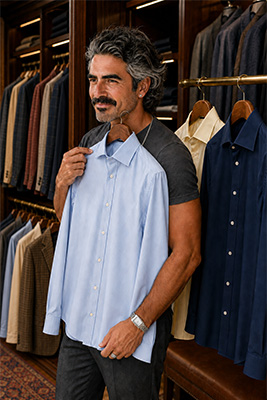 A shirt sits directly beside your face. Its color can brighten your complexion, strengthen your eyes, complement your hair, and make you look rested. The wrong color can drain you, exaggerate redness, emphasize shadows, or make an otherwise handsome man look as though he needs a nap.
That does not mean every shirt must be quiet, dark, or conservative. It means the shirt should serve the man wearing it. I want my clothing to attract favorable attention, but I also want it to allow me to be the star of my own show.
Hold a shirt beneath your face before judging it on the hanger. Look at your complexion, hair, eyes, and facial hair. Does the color give your face more life? Does it make your eyes more noticeable? Does your skin look healthier, or did the shirt just suck every bit of color out of you?
The shirt may be beautiful. That does not mean it is beautiful on you.
Know the Principal Shirt Families
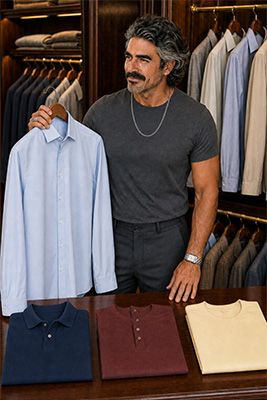 Most men do not need dozens of different shirt categories. They need to understand the principal families and what each one does well.
A button-up shirt carries the widest range. Depending on its collar, fabric, color, pattern, and construction, it can work with jeans, chinos, dress trousers, a sport coat, or a suit. It can take you from a casual dinner to a business meeting without requiring a complete personality transplant.
A polo occupies the useful ground between a T-shirt and a button-up shirt. It is relaxed, but the collar gives it structure.. Wear one with jeans, chinos, tailored trousers, shorts, or beneath an informal sport coat when the fabric and collar are substantial enough.
A henley is casual and masculine. The short button placket gives the neckline more character than a basic T-shirt without making the shirt feel dressed up. It works particularly well with jeans, casual trousers, boots, sneakers, and rugged outer layers.
A well-fitted T-shirt is the foundation of casual dressing. It can be worn alone, beneath an open button-up shirt, under a sweater, or as a clean base layer. The fabric must have enough substance to hold its shape, and the neckline must lie flat. A stretched collar can make a fairly new shirt look ready for the rag bin.
Choose the shirt family according to the occasion. A restaurant, office, date, wedding reception, neighborhood party, and Saturday morning errand do not ask for the same degree of formality. The correct shirt establishes the direction of the outfit before you choose anything else.
Get the Color Right
Color should create a relationship between your face, shirt, trousers, jacket, shoes, and the occasion. It should not look as though five garments met for the first time after you put them on.
Pale blue is one of the most useful shirt colors a man can own. White is crisp and traditional. Pale butter-yellow can add warmth without screaming for attention. Navy provides depth and authority. Burgundy can be rich and masculine when it is paired thoughtfully.
That last part matters. A maroon shirt with a powder-blue suit is not automatically stylish because both colors are individually attractive. Together, they can fight so hard for attention that the man wearing them disappears.
If your size falls anywhere in the XL family, deeper and less reflective colors will often flatter you more. Navy, charcoal, black, forest green, deep burgundy, chocolate brown, and other rich earth tones can reduce visual width and give the body a cleaner outline.
Be cautious with stark white, very pale pastels, neon colors, horizontal stripes, and enormous high-contrast patterns if your goal is to appear leaner. You are not forbidden from wearing them, but you should understand what they may do before handing over your money.
Color Can Change Your Apparent Proportions
 ◄ View ►
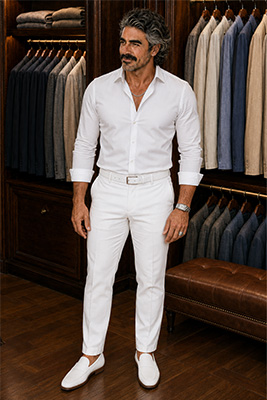
One carrot I dangled in front of myself while chasing the right weight and look was that I would finally be able to wear more white. White can flatter a good tan, and now and then it gives a man a wonderfully fresh, clean appearance.
Well, here I am at 188 pounds with a fit body, and I can wear size 28 pants. If I dress entirely in white, I still think I look like Shamu or Moby Dick.
I find that extremely irritating, but it is something I have to accept. The fit can be correct and the clothing can be beautiful, yet the color still may not create the effect I want.
Anyone who wants to appear thinner can rarely go wrong with an all-black outfit. I swear an all-black outfit takes 20 pounds off. The uninterrupted dark line reduces visual width and allows the eye to travel vertically instead of stopping at every change of color.
This can be especially helpful for men under six feet tall. Wearing a shirt and trousers in the same color, or in closely related colors, can make you appear both leaner and taller. Strong contrast between the top and bottom cuts the body visually into separate sections. A continuous or closely related color story lengthens it.
Solids, Patterns, and Body Shape
 ◄ View ►
I was never much for prints in any of my clothing. The principal exceptions were a navy pinstripe suit or a shirt with a very small, restrained stripe.
When I was morbidly obese, I chose solids almost exclusively because they gave me a thinner appearance. People knew I was fat. I knew I was fat. No one, however, could ever guess my weight because of the clothing choices I made.
I would also wear a dark T-shirt beneath a button-up shirt and leave the button-up completely open. The T-shirt and trousers created one dark central column, while the two open edges of the shirt produced strong vertical lines. Those lines made my body look longer and leaner.
The technique did not conceal my size or magically change my anatomy. It simply presented my body more effectively.
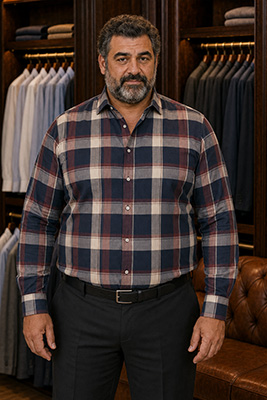
Large plaid, oversized florals, wide horizontal stripes, and high-contrast patterns can broaden a substantial torso. Smaller patterns, vertical details, low-contrast designs, solids, and closely related colors usually create a calmer and more flattering outline.
That is not body shaming. It is understanding how the eye reacts to color, contrast, pattern, and line.
The Man Should Remain the Star of His Own Show
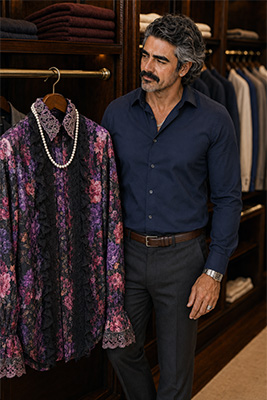 Men’s fashion has recently developed an enthusiasm for lace, enormous florals, ruffles, and other details that once would have been understood as feminine without requiring a committee meeting.
My God, throw on a heavy-floral shirt and a string of PEARLS and you have got Barbara Bush. That is not a masculine look.
I keep hearing about toxic masculinity. Masculinity itself is not toxic, and correcting bad behavior does not require the fashion world to dress men like little girls or old ladies.
I consider all of that feminization, not merely most of it. Other men are free to wear whatever makes them happy, and I am equally free to say that it does not represent me, flatter me, or belong in my collection.
I am hyper-masculine, not toxic. I worked damned hard to build a masculine body and an unmistakably masculine presence. I am not going to bury either one beneath black lace, enormous flowers, ruffles, and PEARLS merely because somebody decided they were fashionable this season.
A shirt can have color, texture, personality, and distinction without wearing the man. The strongest choice supports his appearance and allows the man to remain the star of his own show.
The Final Fit Test
 ◄ View ►
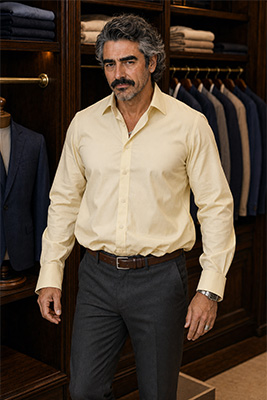
Once the color, style, fabric, and pattern survive inspection, the final test is what kind of alterations need to be done on it.
Start with the areas that are difficult or expensive to change. The collar should fit correctly. The shoulder seams should sit where your shoulders end. The shirt should lie cleanly across your chest without pulling at the buttons.
Excess fabric through the waist, sleeves that are too loose, or cuffs that extend too far can usually be corrected. A skilled tailor can remove the ballooning, taper the body, slim the sleeves, and correct their length without changing the character of the shirt.
If I see a shirt I really have to have, for whatever reason, and it does not fit just right, I buy it anyways. I have found a great tailor, so I simply drop the shirt off and have him work his magic. He always does.
That does not mean buying a shirt with the wrong shoulders, a collar that chokes you, or buttons fighting for their lives across your chest. Tailoring works best when the important structural areas already fit and the remaining problems are reasonable to correct.
Read Both Labels
 ◄ View ►
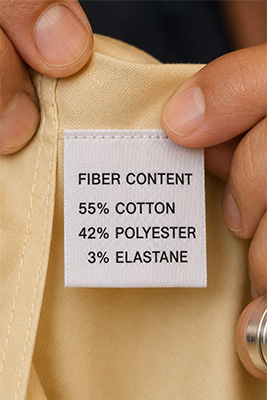
Read the labels on the shirt, check what the material is, and look for the laundry tag. Know how to properly care for it.
A shirt may look and feel wonderful in the store, but the fiber label tells you what you are actually buying. Cotton, linen, polyester, elastane, and blended fabrics behave differently. The percentages matter because they influence comfort, stretch, wrinkle resistance, shape retention, and care.
The care label tells you what ownership will require. Machine washing may be allowed while tumble drying is not. The shirt may need to hang dry, tolerate only a warm iron, or require more attention than you are willing to provide.
Those requirements are not necessarily bad. They simply belong in the purchasing decision.
Buy With a Purpose
A department store can be useful when you want to compare several shirt families, colors, fabrics, and cuts in person. A specialty menswear store may offer better guidance and more distinctive choices. An online retailer can provide far greater variety, particularly after you already know which brands, sizes, and cuts work for you.
When trying an unfamiliar brand, I prefer to examine it in person when possible. Once I know the fit, fabric, and construction, I can confidently compare prices and buy additional colors online.
Before buying any shirt, ask yourself what you will wear it with and where you will wear it. Picture the trousers, jeans, jacket, shoes, and occasion. If the shirt does not work with clothing you already own, it may be attractive without being useful.
The right shirt should flatter your face, respect your proportions, suit the occasion, work with the rest of the outfit, survive realistic care, and make you feel more like yourself.
That is a great deal for one garment to accomplish, but the best shirts do it without making the effort obvious.