
Losing weight changes more than your body. It changes how you shop, how you dress, and how much money you spend on clothing. Most people never think about that side of the journey until they're standing in front of a closet full of clothes that no longer fit.
This can get expensive if you're not a savvy shopper. Imagine going down fifteen pant sizes, from a size 60 waist to a size 30. Even if you only bought three pairs of pants at each size, you'd end up purchasing forty-five pairs before reaching your goal. I didn't quite hit that extreme because I found ways around it, but there were still plenty of times when I bought clothes that only fit for a few months before becoming too large. Sometimes I would have a pair altered to squeeze a little more life out of them, then when I lost more weight I would buy new again.
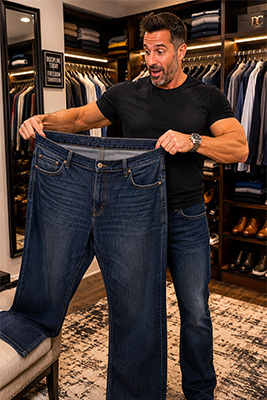
I have gone through a dramatic weight loss. At least for me, it was dramatic. I started at size 60 jeans and ended up at size 29. I'll be a 29 for a short period longer before I hit my goal of 28, yes, a size 28, where I used to be in my 30s, 40s and early 50s. So let's count down the sizes: 60, 58, 56, 54, 52, 50, 48, 46, 44, 42, 40, 38, 36, 34, 32, 30, 29, and soon 28. Seventeen size drops in two and a half years. You tell me I can't do something and I'll do it just to prove you wrong. You would be surprised at the number of people I proved wrong.
One of the biggest mistakes people make is refusing to buy anything until they reach their goal weight. On paper that sounds smart. In reality, it often means walking around in clothes that are hanging off your body and making you look heavier than you really are. There comes a point where oversized clothes stop saving you money and start hiding your success. When you've worked hard to lose weight, it's important to occasionally buy pieces that fit properly because they remind you that the effort is paying off.
For me, tailoring became a valuable tool. A good tailor can take in a pair of pants and buy you several more months before you need to replace them. Spending a little money on alterations is often cheaper than buying an entirely new wardrobe every time the scale moves. Eventually, though, there comes a point where alterations no longer make sense and you need new clothes.
That's when I realized I had been shopping in the wrong places.
I kept donating clothes as I shrank out of them, and one day it occurred to me that if I was donating larger clothing, other people probably were too. I started visiting thrift stores and quickly discovered that the bargains were incredible. Designer labels, quality fabrics, premium brands, and many items looked like they had barely been worn. Some still had original tags attached. It didn't take long before I realized I could build an entire transitional wardrobe for a fraction of what department stores were charging.
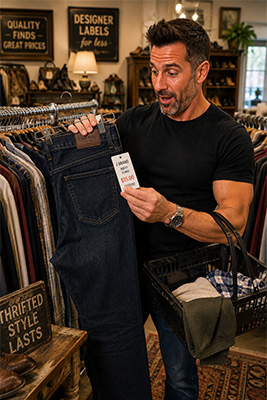
I rarely wear designer clothing because, to me, labels are tacky. You are the star of your show, not Dolce & Gabbana, not Versace. Brandless is best. If someone asks who makes your jeans, just say they're custom. It's the fit that impresses, not the label. Be that as it may, while at a thrift store in Syracuse, NY, I found a pair of J Brand Raffi jeans that retail for $195 for $15. I spent another $20 to have them tailored, and it was well worth it. At a store in Buffalo, NY, I found a pair of Tommy Hilfiger straight leg jeans that retail for $90 for $8. Both pairs were really nice and I got about four months of wear out of them.
Who was going to know where I bought them? Certainly not the people around me. Most people aren't studying clothing labels. They're looking at whether your clothes fit, whether they're clean, and whether you look put together. As long as a garment is presentable, nobody knows if it came from a department store, a thrift shop, or your brother's closet. During a major weight-loss transition, buying smart isn't something to be embarrassed about. It's common sense.
If you absolutely cannot stand the idea of wearing someone else's clothes, there are still inexpensive options. For me, Walmart became one of them. Yes, me. I never expected to be shopping there, and hopefully I never have to again, but during a transition practicality matters more than pride. Their George brand jeans fit surprisingly well, looked good, and cost far less than premium brands. Have them tailored properly and most people would never know the difference. A pair of inexpensive jeans that fits correctly will almost always look better than an expensive pair that doesn't.
The important thing to remember is that this isn't your forever wardrobe. You're in transition. The day is coming when you reach your goal and that's when you reward yourself. That's when you buy the pieces you plan to keep for years. Until then, your job is simply to look good, stay motivated, and avoid wasting money.
Shirts require a slightly different strategy. If you live in t-shirts, buying them new usually makes the most sense. Keep things simple. Four colors are plenty for each size. I know it sounds limiting, but remember that you're not building a permanent wardrobe yet. You're buying clothes to get you through a stage of the journey. Button-down shirts are a different story. Thrift stores often have excellent selections of quality shirts at prices that make no sense. Just inspect them carefully for stains, tears, missing buttons, or excessive wear.
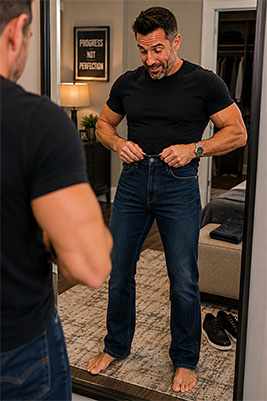
One trick that helped me tremendously was always buying one item in the next size down. If I was currently wearing a size 40, I would buy a pair of size 38 pants even if there wasn't a chance in hell they would fit. Then once a week I would try them on. At first I couldn't even get them buttoned. A few weeks later they would button but feel like a tourniquet. Then one day they fit.
That simple trick did two things. First, it told me what size I would soon need to buy. Second, it gave me proof that progress was happening even when the scale wasn't cooperating. There is something incredibly satisfying about finally cramming your ass into a smaller pair of pants after staring at them in the closet for weeks. It turns weight loss into something tangible. Instead of waiting months to hit your goal, you get small victories all along the way.
Remember that muscle is denser than fat. There may be weeks where your body is clearly changing but the scale doesn't move nearly as much as you'd like. That's normal. Clothing often reveals progress long before the scale does. If your pants fit differently, your shirts fit differently, and you're moving down sizes, you're heading in the right direction.
Jewelry is another area that catches people by surprise. It sounds simple enough. Just have it resized, right? Not always. Many modern pieces are made from stainless steel and coated with gold, silver, copper, or other finishes. Most jewelers aren't equipped to work with those materials and will tell you flat out that they can't help you. Necklaces usually aren't a problem because a little extra room doesn't matter, but rings and bracelets are a different story.
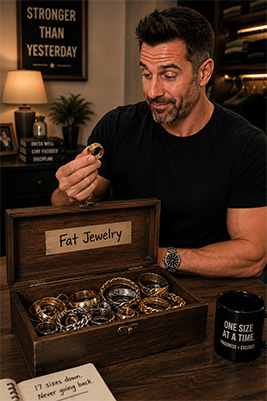
When you lose weight, it's not just your belly or your ass. It's also your arms, wrists, and even your fingers. Your jewelry is going to be too large. I have a wooden box I put all my large jewelry in. Why I keep it, I don't know, since most of it is stainless steel coated with gold or silver and can't be sized by average jewelry stores. I taped a label on the box: Fat Jewelry. There must be 30 pieces in it. I love jewelry.
If you're actively losing weight, think carefully before investing heavily in rings and bracelets. Waiting until your weight stabilizes can save you a lot of frustration and money.
I keep coming back to donating the clothes you've shrunk out of because I think it's the right thing to do. Every size you leave behind represents progress. Somewhere out there is a man standing exactly where you once stood. Maybe he's struggling. Maybe he's embarrassed. Maybe he's trying to lose weight and wondering if he'll ever get there. The clothes that no longer fit you may be exactly what he needs.
You've already gotten your use from them. Let them help somebody else. Besides, if all goes according to plan, you're never going to need them again.