
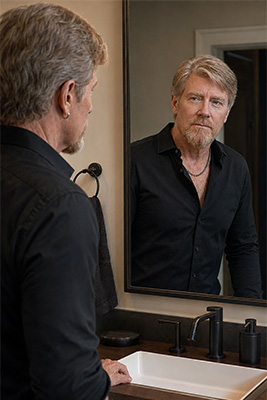
If you look into the mirror and find yourself smiling because you genuinely like what you see, that is wonderful. On the other hand, if you look into the mirror and think, “Yuck, no one is going to want to get close to this,” and a sad expression looks back at you, you have options.
 ◄ View ►
Hair color is not automatically about vanity, insecurity, or denying your age. I believe it is simply another grooming tool. You can use it, reject it, change it, or leave everything exactly as nature currently provides it.
◄ View ►
Hair color is not automatically about vanity, insecurity, or denying your age. I believe it is simply another grooming tool. You can use it, reject it, change it, or leave everything exactly as nature currently provides it.
The important question is not whether society thinks you should color your hair. The question is whether the man looking back at you resembles the man you feel yourself to be.
Gray, silver, and white hair can look exceptional. Some of the most attractive men and women I have ever seen have allowed their hair to become completely silver or white. I would not change a thing about them. That appearance simply was not right for me, and it still is not.
This guide is not going to tell every man to cover his gray. It will tell you how I made my decision, what I learned, what worked for me, and why I believe no man needs to apologize for wanting his exterior to reflect the way he feels inside.
My Calico-Cat Years
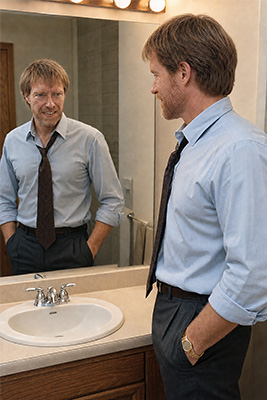 When I was in my thirties, I was exceptionally fit, my career was on its way to outer space, and relationships were about the furthest thing from my mind. My career came first. When I looked into the mirror, the reflection looking back at me managed a halfhearted smile at best. From the neck up, I saw issues and plenty of room for improvement.
I felt like a calico cat. I had medium-light brown hair, blond eyebrows, and a strawberry-blond beard. My chest hair and the hair “down there” were strawberry blond too. For a man who places great value on symmetry, my head did not speak that word.
I had heard that blondes have more fun. I loved my beard, and I decided that the homogeneous appearance I wanted would be achieved by making everything strawberry blond.
My First Professional Colorist
 ◄ View ►
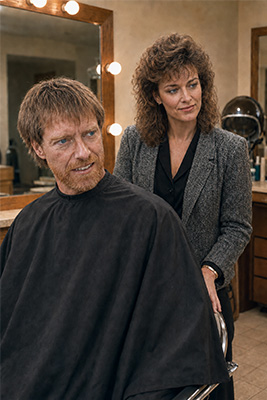
A friend of mine was an expert colorist who owned a salon near where I lived in greater Boston. I discussed the problem with her, and she advised me not to make a dramatic color change all at once. She suggested doing it gradually.
◄ View ►
A friend of mine was an expert colorist who owned a salon near where I lived in greater Boston. I discussed the problem with her, and she advised me not to make a dramatic color change all at once. She suggested doing it gradually.
My career had placed me among a rather conservative banking crowd, so her suggestion made perfect sense. Over approximately six months, she gradually took my medium-light brown hair to strawberry blond so it matched my beard. The people around me had time to adjust to each subtle change, and nobody witnessed one startling transformation on a Monday morning.
It worked. Nobody said a word, at least not to my face. I am sure one or two people snickered behind my back, but I really did not care. When the transformation was complete and I looked into the mirror, the halfhearted smile had been replaced by a very wide grin. I had finally achieved the symmetry I valued so greatly.
That first experience taught me something important. A major color change does not necessarily have to happen overnight. Gradual adjustments allow you to become comfortable with the new color while giving a skilled colorist time to refine it. This can be especially helpful if you work in a conservative environment or simply do not want your hair to become the principal topic of conversation everywhere you go.
Life Handed Me Lemons
 Life sometimes hands you lemons. Try as hard as you might, there are times when you simply cannot make lemonade from them.
I fell into a very deep depression in 2009. It lasted six years and probably would have continued even longer had I not been forced to care for myself as well as another person who was very dear to me and living with diabetes.
Coming out of that depression was not easy. Looking into the mirror was one of my least favorite things in life. I was obese, approximately half gray, and most definitely not a happy camper.
Did I mind the gray hair?
I use this cliché only because it fits so perfectly: Does a bear shit in the woods?
Internally, I did not feel my age. I argued with myself. Should I accept growing older gracefully, as so many others seemed willing to do? If you really knew me, you would have heard the answer from several rooms away:
“FUCK NO!”
There was no connection between the age I felt and the age reflected back at me. Part of my recovery from depression was getting my strawberry-blond hair back. That decision started the ball rolling.
Hair color did not cure my depression, and I would never pretend that it did. It was one deliberate action that helped me begin reconnecting with myself. Restoring the color I loved gave me one visible result I could control at a time when much of my life had felt beyond my control.
The complete transformation did not happen overnight. It took 10 years and a great many baby steps before I became Doug 2.0. I lost a substantial amount of weight, rebuilt my health and body, established better grooming and skincare routines, developed my current style, and regained my confidence.
It was a journey I welcomed, one that challenged me, changed me, and gave me an experience I will never forget. Getting my strawberry-blond hair back was not the entire transformation, but it was one of the things that began it.
Gray Can Be Magnificent
 ◄ View ►
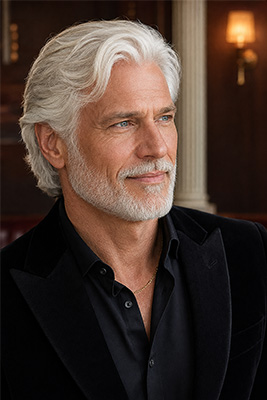
Let me make this perfectly clear. I do not believe gray hair is inherently unattractive. Silver, white, and gray hair can look distinguished, masculine, striking, elegant, and downright beautiful.
◄ View ►
Let me make this perfectly clear. I do not believe gray hair is inherently unattractive. Silver, white, and gray hair can look distinguished, masculine, striking, elegant, and downright beautiful.
I see many silver-haired and white-haired men and women whom I find extremely appealing. I would not change a thing about them. Their hair fits their faces, their coloring, their style, and the way they carry themselves.
It simply did not fit me.
You should not color your hair merely because society is afraid of aging. You also should not keep your gray merely because someone has decided you are obligated to “age gracefully.” I have never understood why aging gracefully must require surrendering every tool that might improve the way you feel about yourself.
If you look in the mirror, see silver hair, and genuinely love it, keep it. Wear it proudly. Make it part of your identity. If you look in the mirror and feel that the gray makes you appear older than you feel, you are allowed to change it.
Neither decision is morally superior. Hair color is not a character test.
Begin With a Professional Colorist
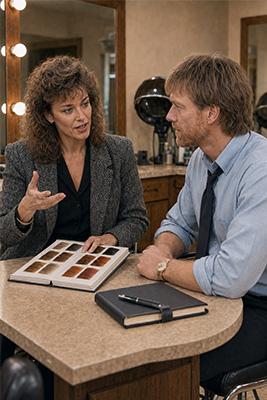 I would advise any man considering coloring his hair to begin by finding a salon with a certified, experienced colorist. That first consultation can save you money, embarrassment, and a great deal of aggravation.
A good colorist will examine your natural hair color, remaining pigment, percentage of gray, skin tone, eyebrows, beard, and the overall condition of your hair. He or she can explain which colors are realistic, which will require considerable maintenance, and which are probably a terrible idea.
You may walk into the salon convinced that you want one particular shade and discover that it will fight with your skin tone, make your hair look flat, or require far more maintenance than you are willing to provide. Listen to the professional. You are paying for judgment as much as application.
For the best result, allow the colorist to color your hair professionally if your budget permits it. You are paying for more than the product. You are paying for color selection, formulation, even coverage, correct timing, and the ability to correct a problem before you walk out looking like an injured tropical bird.
Choosing the Right Color
 ◄ View ►
Jet black is one color that requires extreme caution. On the wrong man, it can look flat, artificial, and harsh against mature skin. It may also make every bit of new gray growth painfully obvious. If jet black is not your natural color, do not assume it will automatically make you look younger merely because it is darker. It may do exactly the opposite.
◄ View ►
Jet black is one color that requires extreme caution. On the wrong man, it can look flat, artificial, and harsh against mature skin. It may also make every bit of new gray growth painfully obvious. If jet black is not your natural color, do not assume it will automatically make you look younger merely because it is darker. It may do exactly the opposite.
A softer dark brown may produce a much more believable result. The correct shade may also be slightly different from the color you had when you were 20. Your skin has changed, your features have matured, and your natural pigment may have changed. The objective is to find the most flattering color for the man you are now, not to recreate an old driver’s-license photograph.
Do not choose from the photograph on the front of a box alone. Hair color involves depth, tone, warmth or coolness, natural pigment, gray percentage, and skin tone. The man smiling on the package is not promising that his color will look the same on your head.
Matching Hair, Beard, and Eyebrows
 ◄ View ►
Head hair does not exist in isolation. Your beard, moustache, eyebrows, skin tone, and eye color all contribute to the complete appearance.
◄ View ►
Head hair does not exist in isolation. Your beard, moustache, eyebrows, skin tone, and eye color all contribute to the complete appearance.
The colors do not have to match with laboratory precision. Natural hair contains variation. A beard may be slightly warmer, darker, or lighter than the hair on the head and still look completely believable. The goal is harmony, not a single solid color painted from the forehead to the chin.
My facial hair now grows in approximately 65 percent gray. I do not like the look, so I color my Van Dyke to coordinate with my strawberry-blond hair. Gray facial hair can look exceptional on another man. On me, it does not produce the reflection I want.
My eyebrows present a different problem. They are naturally blond and end about half an inch short of where I believe they should. I use an old-fashioned sharpenable eyebrow pencil to add a little color in that missing area. I am not drawing an entirely new eyebrow. I simply rub enough color into the area to make the brow appear complete.
Most people are not going to run across the room to conduct a forensic examination of your eyebrows. Choose a color that blends with your hair, apply it lightly, and stop before the result looks as though it was drawn with a permanent marker.
Darker colors are generally easier to blend.
Blonde is a bitch.
What About Body Hair?
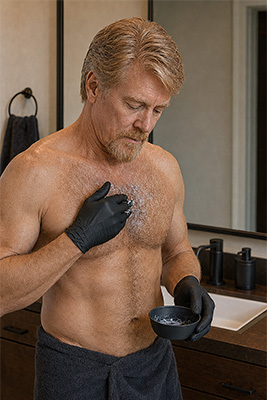 My naturally strawberry-blond beard, chest hair, and hair “down there” contributed to my original desire for greater overall harmony. Most men do not need every hair on their bodies to match exactly, but there is nothing wrong with coloring body hair if that is the appearance you prefer.
Commercial hair-color products often say they are not intended for beards or other coarse body hair. I can tell you from personal experience that I have used them successfully for exactly that purpose. The color worked perfectly well for me.
You will have to decide for yourself whether to follow my example. If you do, perform the required skin-allergy test, use gloves, follow the processing time, and keep the product away from every orifice and all sensitive tissue.
We are coloring the landscaping, not fumigating the building.
Do not apply color to irritated, freshly shaved, cut, or damaged skin. If the product begins burning significantly, rinse it away. Your body is not asking you to wait another five minutes to see what happens.
Coloring chest, stomach, arm, leg, or pubic hair is a personal decision. Natural variation is perfectly normal. Deliberate consistency is perfectly acceptable too. The objective is to create the appearance you want without turning the pursuit of symmetry into an unsupervised chemistry experiment.
Professional Color or Do It Yourself?
 ◄ View ►
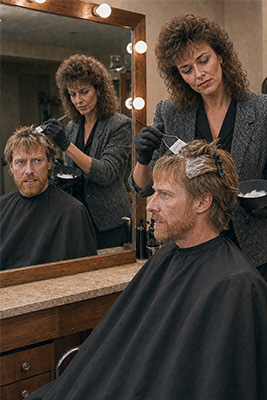
If your budget allows, I believe professional coloring provides the best opportunity for a natural result. This is particularly true when making a major change, moving toward blond or strawberry blond, blending a high percentage of gray, or correcting previous color.
◄ View ►
If your budget allows, I believe professional coloring provides the best opportunity for a natural result. This is particularly true when making a major change, moving toward blond or strawberry blond, blending a high percentage of gray, or correcting previous color.
Professional color costs more, but corrective work costs even more. A colorist can create dimension, adjust warmth, manage difficult gray coverage, and prevent the hair from becoming one flat, artificial block.
If professional coloring every few weeks is beyond your budget, listen carefully during that initial consultation. Learn what color family, depth, and tone work for you, then look for an appropriate do-it-yourself product.
Most men can use a commercial product such as Just For Men. Blondes, unfortunately, usually have a more difficult time. I have not found the standard men’s products particularly useful for achieving the natural strawberry-blond result I want.
I recommend choosing an ammonia-free product.
Just trust me on this.
Follow the directions exactly, including the required allergy test. Do not assume that because you used the same product previously, your skin can never react to it. Wear gloves and protect your clothing, towels, counters, floor, and anything else nearby. Hair dye has an uncanny ability to locate the one surface you forgot to cover.
Apply the product evenly, leave it on for the required time, and wash it out thoroughly. More time does not necessarily create a better result. It may simply create a darker, flatter color or an irritated scalp.
Maintenance Is Part of the Decision
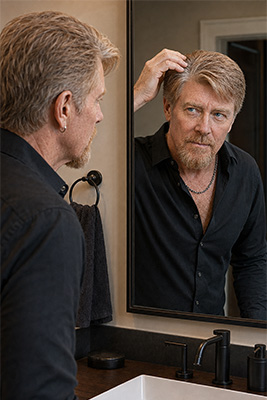 For many men, coloring once every three or four weeks is sufficient. Your schedule will depend on how quickly your hair grows, how much gray you have, and how great the contrast is between your natural roots and the finished color.
The home process itself is not especially difficult. Put it on, leave it for the required time, wash it out, and you are done. The difficult part is choosing the correct color in the first place. That is why I believe the initial consultation with a professional colorist is worth every penny.
Hair continues growing whether or not the timing is convenient. If pale or gray roots create a sharp contrast with dark artificial color, they may become visible quickly. Lighter and softer shades may provide a less obvious transition.
A colorist can explain whether you should touch up only the roots or refresh the color through the entire length. Repeatedly applying color to all the hair may create buildup, excessive darkness, or an unnatural result.
Color is not difficult when you respect what it requires. Choose the shade carefully, follow the timing, maintain the roots, and stop believing that another five minutes will somehow improve everything.
When Hair Color Looks Artificial
 ◄ View ►
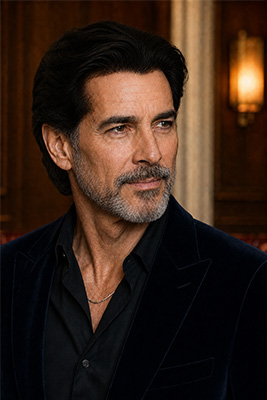
Coloring your hair does not automatically make it look artificial. Poor color selection, uneven application, and neglected maintenance make it look artificial.
◄ View ►
Coloring your hair does not automatically make it look artificial. Poor color selection, uneven application, and neglected maintenance make it look artificial.
A shade may be too dark, too warm, too cool, or completely unrelated to the man’s complexion. One flat color may eliminate all the natural variation that makes real hair believable. The beard and head hair may fight with each other. Roots may become sharply visible, or color may be left staining the skin around the hairline.
If the result is wrong, resist the urge to begin applying one corrective product after another in a panic.
Panic is not a recognized color formulation.
Call a professional colorist and explain what happened. Correcting the problem gradually may be much safer and more successful than attempting another drastic change immediately.
Hair Color Cannot Replace Hair
 ◄ View ►
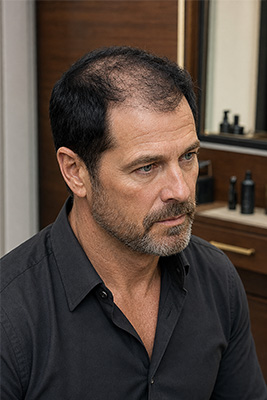
Color can improve harmony, soften gray, and change how hair relates to the face. It cannot restore density or reverse baldness.
◄ View ►
Color can improve harmony, soften gray, and change how hair relates to the face. It cannot restore density or reverse baldness.
Very dark hair against a pale scalp may make thinning more visible. A softer or lighter shade may reduce that contrast and create the appearance of greater coverage. A professional colorist can help select a shade that works with the amount of hair you actually have.
If your hair is thinning, you still have options. You can keep and color it, allow the gray to remain, cut it shorter, shave your head, investigate transplantation, or consider a quality hair-replacement system. We will discuss those larger choices more thoroughly in future guides.
Whatever you decide, let it look intentional. Color should support the hair you have, not become desperate camouflage for hair that is no longer there.
Coloring Hair Is Not Feminine
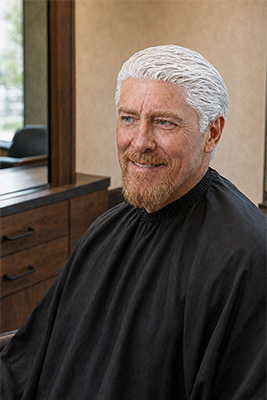 I am a very masculine man. I do not have a feminine bone in my body, and I do not consider it feminine to make my exterior reflect how I feel inside.
Men trim their beards, remove nose and ear hair, shape their eyebrows, whiten their teeth, select flattering clothing, tailor their trousers, lift weights, care for their skin, and wear fragrance. Hair color is simply another grooming tool.
Using it does not alter your masculinity any more than applying sunscreen or having your shirt sleeves shortened. Masculinity is not measured by the number of gray hairs a man refuses to cover.
If coloring your hair or beard makes you happier with your appearance, do it. You do not require permission from coworkers, relatives, strangers, or some self-appointed authority on how an older man is supposed to look.
Assess the problem, choose the solution, and stop worrying about the spectators.
Look as Old as You Feel and Act
 I believe you should look as old as you feel and act. At 75, I have no aches, pains, or joint problems. I am in excellent health, and I do not spend my time having conversations centered on knee and hip replacements, arthritis, sciatica, blood pressure, or everything else that has supposedly gone wrong with age.
That is not how I define myself. I am far too busy conquering the world for a second time.
I will continue coloring my hair and beard, watching my weight, following my skincare routine, and maintaining my gym regimen. I do these things because they help my exterior reflect the energy, health, ambition, and masculinity I feel inside.
To hell with what anyone else thinks.
Find the Smile
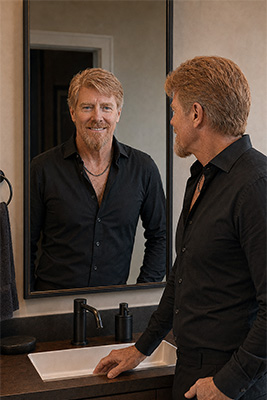 The point of my story is simple. When you look into the mirror, if you do not see a pleasant, genuine smile because you are happy with what is looking back at you, do something about it.
That may mean coloring your hair. It may mean allowing it to become completely silver or white. It may mean coordinating your beard and eyebrows, choosing a softer shade, correcting a poor color, or shaving your head entirely.
Make the decision for yourself. Do not color because society tells you that gray is unacceptable. Do not remain gray because someone tells you that changing it means you are denying your age.
Use professional guidance to avoid preventable mistakes. Maintain the color properly once you choose it. Then look into the mirror and decide whether the reflection finally resembles the man living inside it.
I like my smile. I like looking into the mirror and seeing a virile, middle-aged man with more vim and vigor than almost anyone I know.
The correct color is the one that lets you look into the mirror and say, “Yes. That is me.”