
Most clothing is made to fit thousands of men. Tailoring makes it fit you.
When many men hear the word tailoring, they picture an expensive suit, a tape measure draped around someone’s neck, and a bill large enough to require smelling salts.
That is one kind of tailoring. It is certainly not the only kind.
Tailoring, as we’re discussing it here, simply means changing a garment so it works better with your body. That may involve shortening a pair of pants, tapering the legs of jeans, taking excess fabric from the body of a shirt, shortening sleeves, adjusting the waist of trousers, or making any number of other changes that improve fit and proportion.
The clothing hanging in a store was not made for you. It was made for a size.
That distinction matters.
Two men can have the same waist measurement and completely different bodies. One may have a flat stomach and a full backside. Another may carry weight through his middle and have almost no ass at all. One may have muscular thighs. Another may have thin legs. They can both wear the same nominal size, but there is no reason to expect the same garment to flatter both of them.
Manufacturers have to create clothing that fits enough people to sell profitably. You only need your clothing to fit one person.
You.
Tailoring Can Save You Money
Having clothes tailored can also save you a lot of money.
 ◄ View ►
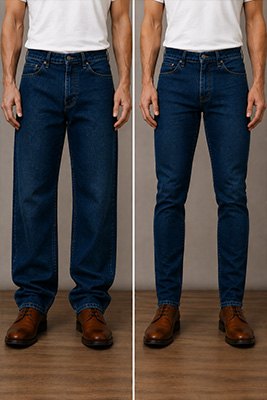
While Walmart is not my favorite store, I’ll give credit where credit is due. They sometimes have great groups of clothing, and I’ve bought many pairs of jeans there over the years. They’re comfortable, they wear very, very well, and some of them look damn good on me.
For around $20, I can buy a pair of jeans that already works well with my body. But they can work better.
Take about half an inch off the length and give the legs a slightly more aggressive taper from the crotch to the hem, and I end up with jeans that fit me almost perfectly. They accentuate me from the waist down, flatter my proportions, and can look like I spent $500 on them.
My total investment is around $50.
That’s one of the things men often misunderstand about tailoring. You don’t necessarily spend more money to look better. Sometimes you spend less by buying a reasonably priced garment with good potential and paying to have it adjusted for your body.
And before anyone gets the wrong idea, I don’t buy all my jeans from one place. I like to stay fashionable, and different brands, cuts, washes, and styles all have a place in my closet. The point is simply that a $20 pair of jeans with the right potential can become an exceptional pair of jeans when another $30 is spent putting the fit where it belongs.
There is another way tailoring can save you money that many men never consider.
If you make seasonal changes to your clothing collections, don’t automatically count out last season’s long-sleeve shirts when warmer weather arrives. Some of them may be excellent candidates for conversion into short-sleeve shirts.
Think about what that could mean. If you had ten long-sleeve shirts from last season and converted only five of them, you would already have a substantial head start on this season’s short-sleeve collection. You could then add a few new shirts in current colors, patterns, or styles rather than starting over.
Of course, not every long-sleeve shirt will be a good candidate. The fabric, cut, cuff construction, pattern, and overall design all matter. A shirt that looks natural with shortened sleeves is worth considering. One that looks as though somebody attacked it with scissors after three martinis is not.
But when the garment is right, you may be able to extend its useful life, refresh your seasonal choices, and spend your money on the pieces you genuinely need instead of replacing everything.
That is another reason to stop thinking of tailoring only as fixing clothes that don’t fit. Sometimes tailoring can give good clothing an entirely new purpose.
Start With the Right Garment
Before discussing what a tailor can do, we need to be clear about what a tailor cannot do.
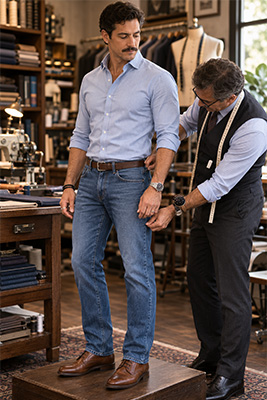
A tailor is not a magician.
The best results usually begin with a garment that already fits reasonably well in the places that are difficult or expensive to change. Tailoring then improves what is already there.
This is particularly important with jackets, jeans, and other structured or heavily constructed garments. A sport coat with badly fitting shoulders may not be a smart purchase just because the waist can be taken in. Jeans with the wrong rise or badly placed back pockets may never flatter you, no matter how beautifully the legs are tapered.
Sometimes the smartest alteration is leaving the garment in the store.
Learn to look for potential. If the important parts fit and the remaining problems are reasonably simple to correct, you may have found something worth buying.
Pants Can Change How Your Entire Body Looks
Pants occupy a tremendous amount of visual territory. From your waist to your shoes, they influence how long your legs appear, how heavy or slim you look, how your backside looks, and whether your body seems balanced.
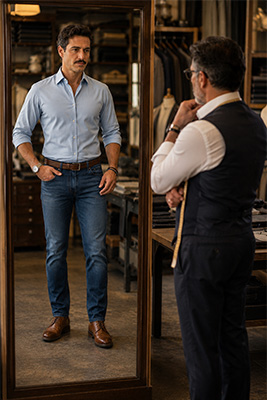
Small changes can make a surprisingly large difference.
Depending on the construction of the garment and how much fabric is available, pants may be altered at the waist, seat, thighs, lower legs, hem, and other areas. They may be shortened, lengthened when sufficient fabric exists, tapered, let out, taken in, or adjusted to create a cleaner line.
The goal is not to make every man wear tight pants.
Good fit is not the same thing as tight fit.
A heavier man may look better with enough room for the fabric to fall cleanly instead of clinging to every contour. A thin man may need to avoid excess fabric that makes his legs disappear inside his pants. A muscular man may need room through the thighs while benefiting from a taper below them.
The right alterations depend on the man.
Jeans Deserve Special Attention
Jeans may be the most democratic garment a man owns. Young men wear them. Old men wear them. Thin men wear them. Heavy men wear them. Rich men wear them. Men who have no interest in fashion wear them.
 ◄ View ►
Unfortunately, a lot of men are wearing jeans that do absolutely nothing for them.
A good pair of jeans can flatter almost any body type, but the process begins with understanding what needs to be flattered and what needs to stop being exaggerated.
Consider the poor bastard without an ass.
If jeans have too much room in the seat, excess fabric can sag and collapse beneath the back pockets. Instead of disguising a flat backside, the jeans announce it. Pocket size and placement can make matters better or worse. Large pockets, low pockets, or pockets positioned too far apart may visually flatten the area even more.
A better starting cut, combined when appropriate with adjustments to excess fabric through the seat and legs, can create a cleaner silhouette and make the backside appear more defined.
No, a tailor cannot sew you a new ass.
He may, however, be able to stop your jeans from making the one you have look worse.
The man with a fuller backside has a different problem. Jeans that are too tight through the seat may pull, strain, distort the pockets, and create horizontal tension lines. Going up a size may solve that problem while creating too much room at the waist.
This is where buying for the more difficult area and altering the easier one may make sense. A pair that accommodates the seat and thighs may sometimes be adjusted at the waist for a cleaner fit.
Men with large thighs often know the frustration of jeans that fit at the waist but grab the legs like sausage casings. The answer is not necessarily a larger size everywhere. A different cut may provide the necessary room through the thighs, after which the lower leg can sometimes be tapered to avoid a baggy appearance.
Men with thin legs have the opposite problem. Too much fabric can make the lower body look even smaller. A controlled taper may create a cleaner line and better proportion without turning the jeans into skinny jeans.
A man carrying weight through his stomach needs to pay particular attention to rise and where the waistband naturally sits. This is one of those situations where choosing the correct jeans matters more than expecting alterations to solve everything. A waistband fighting the body all day will not become comfortable simply because the hem is perfect.
Shorter men can often benefit from eliminating unnecessary fabric stacking at the ankle. Excess length visually interrupts the leg line and may make the legs appear shorter. A proper hem and a thoughtful taper can create a cleaner, longer-looking line.
Very tall men have their own issues. Pants that are even slightly too short can look accidental, while an overly narrow leg may exaggerate height and thinness. Proportion still matters.
This is why saying, “I wear a 34 waist,” tells us very little about whether a pair of jeans will flatter you.
Dress Pants and Trousers
Dress pants are less forgiving than jeans because smoother fabrics often reveal fit problems more clearly.
Excess fabric may pool around the ankles. A poor fit through the seat can create sagging or pulling. Legs that are too wide may overwhelm a smaller frame, while trousers that are too narrow may cling where they should drape.
Common adjustments can include the waist, seat, hem, and leg width. The amount that can safely be changed depends on the garment’s construction and the fabric available inside the seams.
The break of the pants also matters. The break is where the trouser leg meets the shoe and creates a fold or crease. Some men prefer little or no break. Others prefer a slight break. Style plays a role, but so do height, leg shape, trouser width, and the overall look you are trying to achieve.
There is no universal rule requiring every man to have exactly the same trouser break.
There is, however, a difference between an intentional break and six inches of fabric collapsing onto your shoes.
Shorts Need to Fit Too
Shorts are often ignored in conversations about tailoring, perhaps because men assume casual clothing does not matter as much.
It does.
Length can dramatically change the appearance of your legs. Excessively wide openings may make thin legs look thinner. Very tight shorts may overemphasize larger thighs. A waistband that fits poorly creates the same problems it would in longer pants.
Not every inexpensive pair of shorts is worth altering, but if you love the fabric, color, or overall style, a relatively simple adjustment may turn an almost-right pair into one you wear constantly.
Shirts Are Supposed to Work With Your Torso
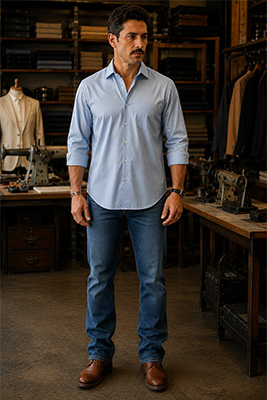
A shirt can fit correctly at the shoulders and chest while leaving enough extra fabric around the waist to shelter a small family.
 ◄ View ►
This is common because manufacturers are trying to accommodate many bodies.
Depending on the shirt and its construction, excess fabric may sometimes be removed through the side seams or with darts. Sleeves may be shortened in some garments. Overall length may sometimes be changed. The goal is to create a shirt that follows your body appropriately without clinging to it.
Again, tighter is not automatically better.
A man with a stomach usually does not benefit from a shirt stretched tightly across it. A very thin man may look overwhelmed by a large box of fabric. A muscular man may need room through the chest and upper arms but less fabric through the waist.
The garment should work with the body in front of us, not an imaginary body we wish were there.
Casual Button-Front Shirts
Casual button-front shirts can sometimes be improved by reducing excess fabric through the body, adjusting sleeve length, or changing overall length when construction permits.
The way you intend to wear the shirt matters.
A shirt worn untucked needs an appropriate finished length. Too long and it can resemble a nightshirt. Too short and it may expose your stomach every time you reach for something.
If you plan to wear a shirt both tucked and untucked, tell the person doing the alterations. That information matters.
Dress Shirts
Dress shirts bring additional considerations.
The collar needs to fit correctly. The shoulders need to be reasonably right. Sleeve length matters, particularly when the shirt is worn beneath a jacket. Excess fabric through the torso may sometimes be reduced to create a cleaner line.
A man with a large neck and smaller torso often knows the problem well. He buys for his neck and ends up swimming in fabric below it. Alterations may help considerably, depending on the shirt.
The same is true for athletic men who need room through the chest and shoulders but have a significantly smaller waist.
This is one reason a properly fitted dress shirt can look so much more expensive than it actually is.
Polo Shirts
Polos can be deceptively difficult.
Too much fabric through the body can look sloppy. Sleeves that flare widely away from thin arms may make the arms look smaller. A polo that is too long can distort your proportions, particularly when worn untucked.
Some polos can be altered through the body or length. Sleeves may sometimes be adjusted, depending on their construction.
Whether the work is financially sensible depends on the garment. Spending a fortune rebuilding a cheap polo makes little sense. Spending a modest amount to improve a favorite high-quality polo may be another matter.
T-Shirts
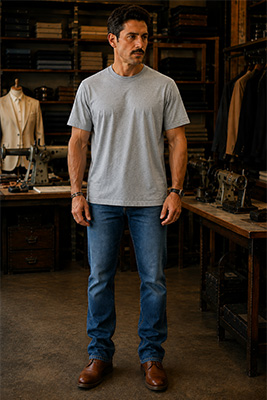
Yes, T-shirts can sometimes be tailored.
 ◄ View ►
Whether they should be is a different question.
A T-shirt with a great neckline, excellent fabric, and the right shoulder fit may be worth adjusting if the body is too wide or the length is wrong. Sleeve length and opening can also have a major effect on appearance.
A sleeve that ends at a flattering point and sits closer to the arm can make the upper body appear stronger. Too much fabric through the torso can make a fit man look shapeless. Too little fabric can make almost anyone look as though he lost a fight with a sausage casing.
For inexpensive everyday T-shirts, buying a better cut is usually the smarter answer. For a premium shirt, a favorite graphic, or something difficult to replace, alterations may be worth considering.
Sweaters and Pullovers
Sweaters, knit pullovers, and similar garments require caution.
Knitted construction is different from ordinary woven fabric, and not every alterations person works with it. Some changes may be possible, including sleeve or body adjustments, but the feasibility depends heavily on how the garment was made.
This is a category where you should ask before assuming.
A good tailor will tell you what can be done.
A very good tailor will also tell you when you should save your money.
Jackets and Sport Coats
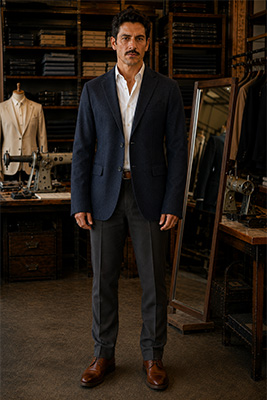
Jackets can produce some of the most dramatic improvements in a man’s appearance, but they can also involve some of the most complicated and expensive alterations.
 ◄ View ►
Sleeve length is commonly adjusted. The body may often be taken in or let out within available allowances. The waist may be shaped to create a cleaner silhouette. Other changes may be possible depending on construction.
Shoulders are another matter.
Major shoulder work can be complicated, expensive, and sometimes simply not worth doing. This is why getting the shoulders reasonably right when buying a jacket is so important.
A jacket that fits well can visually broaden the shoulders, define the torso, and create better proportion. A badly fitting one can make a strong man look sloppy and a smaller man look as though he borrowed his father’s clothes.
Suits
Suits deserve more discussion than I’m going to give them here.
The jacket and trousers have to work individually and together. Sleeve length, trouser length, waist suppression, seat fit, leg line, shirt cuff exposure, and overall balance all contribute to the result.
We will deal with suits elsewhere because trying to compress the subject into a few paragraphs would do you no favors.
For now, understand this: an expensive suit that fits poorly is still a poorly fitting suit.
Price does not rescue bad fit.
Outerwear
Coats and jackets present their own challenges because they may include linings, insulation, leather, technical fabrics, zippers, complex seams, or other construction details.
A topcoat may offer alteration possibilities that a heavily insulated technical jacket does not. A leather jacket may require someone experienced specifically with leather. A bomber jacket may have ribbed bands or zippers that complicate changes.
Sleeves, body width, and length may sometimes be adjusted, but the answer depends entirely on the garment.
Outerwear is also designed to accommodate what you wear underneath it. A coat that looks beautifully fitted over a T-shirt may become useless when you put a sweater beneath it.
Tell the tailor how you actually wear the garment.
The Alterations That Often Deliver the Biggest Return
Some alterations can make a substantial visual difference without rebuilding an entire garment.
Correcting pant length is an obvious example. So is tapering an overly wide leg when the rest of the pants fits well. Removing excess fabric from the body of an appropriate shirt may dramatically improve its appearance. Correcting sleeve length can make shirts and jackets look more intentional and polished.
These are not universal recommendations. Every garment and every body is different.
The point is that relatively modest changes can sometimes produce disproportionate results.
Half an inch matters.
An inch matters.
The angle at which a trouser leg narrows matters.
Where a shirt ends matters.
Men often assume other people will not notice such small differences. They may not consciously identify them, but they often notice the result.
They simply think you look better.
When Tailoring Is Probably Not Worth It
Just because something can technically be altered does not mean it should be.
Major reconstruction can quickly become expensive. Complicated shoulder work on a jacket may cost more than finding a better jacket. Dramatically changing the size of a garment may distort pockets, seams, proportions, and other design elements.
Some fabrics show old stitch marks after seams are moved. Some garments do not contain enough extra fabric to be let out. Some inexpensive construction methods make alterations difficult. Some details simply cannot be moved without creating another problem.
This is where an honest professional is invaluable.
Ask what can be done.
Ask what it will cost.
Then ask the most important question: “Would you do it if this were your garment?”
You may learn a lot from the answer.
Look at the Difference
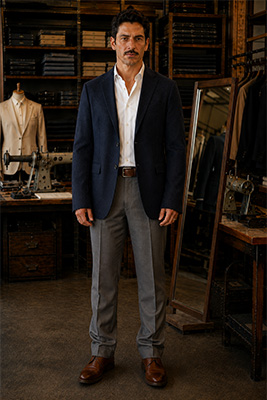
We have discussed hems, tapers, waists, seats, sleeves, shirts, jackets, jeans, and body types. But tailoring makes the most sense when you can see what all those small decisions accomplish together.
 ◄ View ►
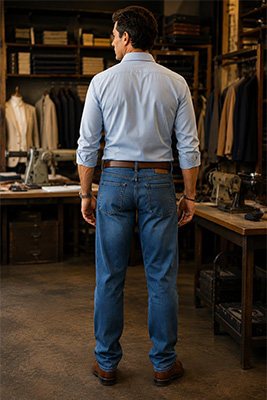
Nothing about the man’s body changed between these two images.
He did not lose 20 pounds.
He did not spend six months in the gym.
He did not suddenly become taller.
The clothing changed.
Look at how the pants fall. Look at the amount of excess fabric. Look at the relationship between the shirt and the torso. Look at the sleeve length. Look at the overall line from shoulders to shoes.
The better fit can make his shoulders appear broader, his waist look cleaner, his legs appear better proportioned, and the entire man seem more polished.
That is why tailoring matters.
It is not about forcing your body into somebody else’s idea of perfection. It is about changing how clothing works with the body you already have.
You may be tall, short, heavy, thin, muscular, flat-assed, broad through the middle, narrow through the shoulders, or built in a way no manufacturer’s size chart seems to understand.
Welcome to being human.
The answer is not always tailoring. Sometimes you need a different size. Sometimes you need a different cut. Sometimes you need a different brand. Sometimes the garment belongs back on the rack.
But when you begin with the right garment and make intelligent adjustments, the result can be remarkable.
You do not need $500 jeans to look like you are wearing $500 jeans.
Sometimes you need a $20 pair with potential, another $30 in alterations, and someone who knows exactly where half an inch needs to disappear.