
The size printed inside a garment is not a judgment about your body. At best, it is one manufacturer's opinion about which body might fit inside that particular piece of clothing.
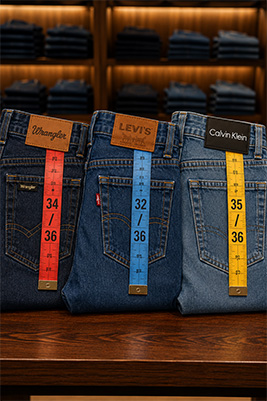
There was a time when finding your size seemed straightforward. Measure your waist, buy pants carrying that number, and get on with your life.
Things have changed over the decades of my existence.
Today, the same man can wear three different sizes in three different brands. A familiar size can change when the cut changes. Add stretch to the fabric and the number may change again.
Geez, it is 2026. Can't we have some sizing standards?
Apparently not, so we need a practical way to work around the problem.
In our previous guide, we discussed visiting physical stores, trying on several brands, and recording the sizes that fit before shopping online. That was the introduction. Now let's turn those scattered notes into something far more useful: your Personal Size Profile.
There is nothing technical or complicated about it. Your profile can live in an ordinary note on your phone. It is simply a record of what fits your body, what flatters your proportions, and what you should remember the next time you shop.
Begin With the Fitting Room
For most men, the easiest and most reliable place to begin is a physical store. You don't need special equipment, and you don't need to know how to measure every part of your body. You need clothes, a fitting room, a mirror, and your phone.
Choose one type of clothing at a time. If you need jeans, start with the style you normally prefer and try it in several brands. A man might discover that he wears a 29 in Lee, a 31 in Levi's, and a 28 in George at Walmart.
The numbers disagree, but the mirror settles the argument.
Do more than stand still and decide that the waistband closes. Sit down. Bend. Raise one knee. Put your hands in the pockets. Look at the front, side, and back. Pants that appear fine while you stand like a department-store mannequin may pull, sag, pinch, or flatten everything worth displaying as soon as you move.
For shirts, raise your arms and reach forward. Make sure the buttons aren't pulling across the chest. Check whether the shoulder seams sit where your shoulders actually end. Turn sideways and look at the amount of fabric around your waist. Then turn around and check the back.
A fitting room is not merely where you discover whether something closes. It is where you learn how the garment behaves on your body.
When you find a winner, take out your phone. Record the brand, labeled size, style or model name, and whether the fit is close, regular, or relaxed. Add the fabric composition and stretch percentage when they matter.
The fastest method may be photographing the labels. One photograph can capture the brand, size, fabric content, and care information without requiring you to type everything while half dressed in a fitting room.
Add one short observation in your own language: perfect through the thighs, best rise, too loose in the seat, excellent shoulder fit, or needs more room through the chest. Those few words may become more useful than the size itself.
That is the beginning of your Personal Size Profile.
The Holy Grail of Measurements
 ◄ View ►
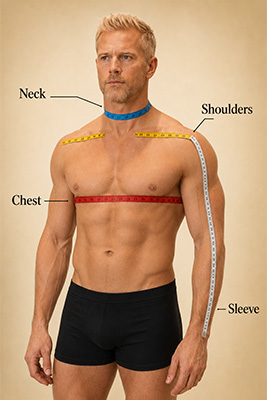
There are times when actual body measurements are valuable, particularly when an online retailer provides a detailed chart or when you are buying clothing that is difficult to try locally.
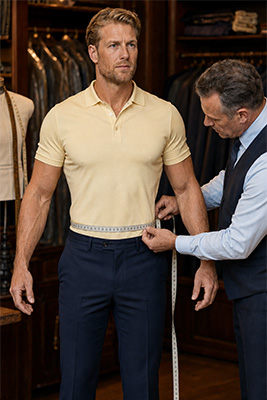
If you already have a tailor, pay him a visit. Chances are he will take the measurements for you, giving you the holy grail of measurements.
A professional knows exactly where the tape belongs, how tightly it should sit, and which measurements matter for different garments. He can give you accurate numbers for your neck, chest, natural waist, hips or seat, sleeve, and inseam without turning the process into an amateur wrestling match with a tape measure.
If you don't have a tailor, our guide Finding The Right Tailor might be a very good read at this point.
Your third option is measuring yourself. Use a flexible cloth measuring tape, not the metal tape from your toolbox. A rigid tape is excellent for measuring lumber. Your torso is not lumber.
If you choose the do-it-yourself route, measure naturally. Don't suck in your stomach, pull the tape until circulation stops, or stand in a position you could not maintain through dinner. You want the measurements of the body you actually dress.
It also helps to measure clothing that already fits beautifully. Lay a favorite pair of pants or shirt flat and record its important dimensions. Some online charts describe the body intended to wear the garment. Others provide the measurements of the finished garment. Knowing both your body and a successful piece of clothing gives you two useful points of comparison.
Measurements provide a strong baseline, but even the holy grail cannot tell you how every manufacturer interprets them. Your tailor can measure your waist perfectly. He cannot force three jeans companies to agree on what that measurement should be called.
That is why professional measurements and fitting-room experience work so well together. One tells you the truth about your body. The other tells you what the clothing company did with it.
Size Is Only One Part of Fit
 ◄ View ►
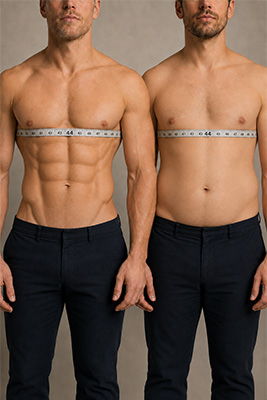
Men often assume that if a garment doesn't look right, they chose the wrong size. Sometimes they did. Other times, the number is correct and the shape is wrong.
◄ View ►
Men often assume that if a garment doesn't look right, they chose the wrong size. Sometimes they did. Other times, the number is correct and the shape is wrong.
I have a barrel-shaped chest. It looks great, but factory-made shirts don't always know what to do with it.
A button-up shirt may fit my neck, shoulders, and chest, then begin tapering beneath the armpits as though the manufacturer expected an entirely different man to appear below them. Going up a size can create excess fabric everywhere else without solving the underlying problem.
The label isn't necessarily wrong. The manufacturer's idea of the body inside that label is wrong for me.
 ◄ View ►
Approximately half of the button-up shirts I buy need some adjustment. My tailor can usually correct the problem for ten dollars. I don't need a technical explanation of every alteration. I need the finished shirt to respect my proportions and flatter the body I worked damn hard to build.
◄ View ►
Approximately half of the button-up shirts I buy need some adjustment. My tailor can usually correct the problem for ten dollars. I don't need a technical explanation of every alteration. I need the finished shirt to respect my proportions and flatter the body I worked damn hard to build.
This is why your Personal Size Profile should record more than medium, large, 30, or 32. Include the cuts that work.
For shirts, you may discover that classic fit provides too much fabric, slim fit pulls across the chest, and athletic fit accommodates your shoulders while following the torso properly. Another man may reach the opposite conclusion.
For pants, pay attention to the rise, seat, thigh, and leg opening. Two pairs with the same waist and inseam can create completely different silhouettes because those other measurements changed.
Jackets add shoulder width, chest room, sleeve length, and overall length to the equation. Outerwear may need additional room for layers underneath.
The useful question is not simply, "What size am I?" It is, "Which size, in which cut, from which brand, made from which fabric, fits the way I want it to fit?"
That sounds like a longer question, but your profile gives you the answer without starting over every time you shop.
Put the Fabric in Your Profile
A size without fabric information is an incomplete entry.
Two pairs of jeans from the same company can carry the same waist size and still fit differently because one is rigid denim while the other contains elastane. One holds its shape firmly. The other expands when you sit, bend, or move.
That difference became very clear while I was losing weight.
For most of my life, jeans meant traditional denim. When stretch versions appeared, I considered them an unnecessary alteration to something that had worked perfectly well for decades. Curiosity eventually overruled stubbornness during a trip to Walmart to check my changing size.
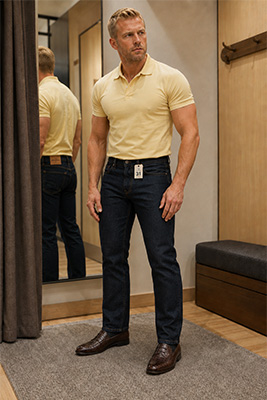
The size I expected to wear fit. Then a smaller pair fit. I tried one more size down, thinking I might buy it as a carrot on a stick for losing the remaining 7.25 pounds.
That pair already fit too.
 ◄ View ►
I stood there smiling at the result. This old dog had learned a new trick, but the more useful discovery was that the number alone had told me almost nothing. The fabric had changed what the size could accommodate.
That is why your Personal Size Profile should include the material beside every successful fit. You might record:
Levi's, size 31, rigid denim, close through thighs.
Or:
Levi's, size 30, stretch denim, comfortable waist, better movement.
Those entries describe two different fitting experiences even though they come from the same brand.
When an item fits particularly well, photograph the fabric label. Look for elastane, spandex, or another stretch fiber and record the percentage when it is shown. A small amount may provide gentle flexibility without making the garment feel elastic. A larger amount may substantially change how it moves, holds its shape, and fits throughout the day.
The same principle applies beyond jeans. Stretch can change how a shirt accommodates the chest, how pants fit through the seat and thighs, and how comfortably a jacket moves across the shoulders.
Do not assume that stretch automatically means you should buy a smaller size. The cut, construction, and amount of stretch still matter. Try the garment and let the mirror make the decision.
The important lesson is simple: when the fabric changes, your working size may change with it. Record both, because the number without the material tells only half the story.
Give Each Type of Clothing Its Own Profile
Don't force everything into one list. Divide the note on your phone into simple sections.
Under jeans, record the brand, style, waist, inseam, rise if known, and fabric. Under dress pants, note whether the waist sits differently and whether the material has stretch. Under shirts, include the collar size when relevant, sleeve length, cut, and any recurring fit issue.
You might create sections for:
• Jeans
• Dress pants
• Casual shirts
• Dress shirts
• Sport coats and suits
• Outerwear
Only create sections for clothing you actually buy. This is supposed to make life easier, not become a cataloging hobby unless cataloging happens to be your hobby.
Keep the notes practical. "Navy shirt, medium, perfect shoulders, tight at waist" is useful. A paragraph describing the emotional journey of trying it on is probably unnecessary.
Photographs can help here too. Take a picture of the garment from the front and side when you love the fit. That gives you a visual standard for future purchases. You are no longer relying on memory to decide whether a new shirt fits as well as the old one.
When shopping online, compare the retailer's chart with the appropriate section of your profile. Determine whether the chart refers to body measurements or garment measurements. Check the material and cut. Read customer comments for repeated fit observations, but don't allow one stranger's review to overrule evidence gathered from your own body.
The profile won't eliminate every return. It will eliminate a great deal of blind guessing.
Keep It Current
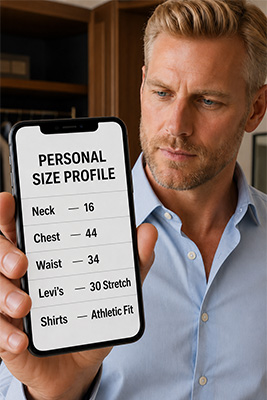
Your Personal Size Profile is not carved in stone.
Bodies change. You may lose weight, gain muscle, recover from surgery, or simply notice that your proportions have shifted. Manufacturers change too. A company can revise a familiar cut or fabric without asking your permission.
When your body changes substantially, return to the fitting room and update the sections affected. You don't need to rebuild the entire profile because your jeans size changed. Check the clothing most likely to be affected and continue from there.
Date important entries, particularly during weight loss or body transformation. A note from six months ago may describe a body you no longer have.
If a familiar item suddenly fits differently, compare the style name and fabric composition before assuming your body changed. The manufacturer may have quietly altered the product.
Finding your size is not about forcing your body to match a number printed on a label. It is about learning which clothes match your body.
The clothing industry may never give us consistent sizing standards. Fine. Your Personal Size Profile can give you something more valuable: a record based on professional measurements when available, real fitting-room experience, careful observation, and what actually flatters you in the mirror.
The label makes a suggestion. Your profile knows better.