
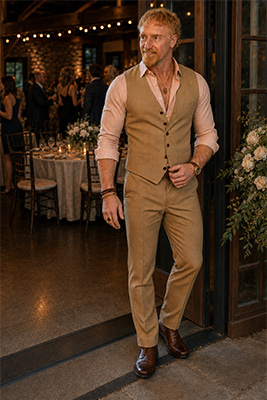
 Hopefully, you’ve already read our guide, “The Mirror Test.” If you haven’t, you may want to read it before continuing with this guide.
“The Mirror Test” helps you look at yourself honestly and recognize the man standing in front of you. This guide takes the next step. It’s about carrying that confidence beyond the mirror and into a room filled with other people.
If you’ve followed the guides throughout this site, then by the time you arrive at your destination, almost everything should already be in place. Your clothing fits properly. Your colors work together. Your shoes are polished. Your grooming is handled. Your jewelry and fragrance are appropriate for the occasion.
You’ve already done the work required to make a strong impression. Don’t throw away all that preparation by creeping through the doorway, staring at the floor, fumbling with your phone, or moving as though you hope no one notices you.
So when you walk into that room, you are the star of your own show, walking on your very own red carpet.
Your Entrance Begins Before the Door Opens
Confidence doesn’t suddenly appear when you cross the threshold. It begins a few moments earlier.
Before entering, take one calm breath. Straighten your clothing if necessary, check your posture, put away your phone, and remind yourself why you’re there. You may be attending a party, meeting someone for dinner, arriving at a business function, or walking into a room where you don’t know a soul. Whatever the occasion, enter with a purpose.
You don’t need to burst through the door or make a grand production of your arrival. You simply need to look as though you chose to be there and expect to enjoy yourself. In this case, less is more.
That quiet decision changes the way you move.
The Way You Walk Matters
Many men have never thought about the way they walk. They learned to get from one place to another, and that was the end of the lesson. Unfortunately, a poor gait can undermine an otherwise strong appearance.
I see it at the gym regularly. Some men move with an excessive side-to-side motion through the hips that appears more feminine than masculine. Others shuffle, rush, look at the floor, or move as though they’re trying to make themselves smaller.
Trying to teach someone how to walk through a list of verbal instructions can make the problem worse. A man may become so preoccupied with the position of his shoulders, feet, arms, and hips that he moves like a machine in need of oil.
It’s far more useful to see a confident masculine gait demonstrated.
Watch the Walk
Don’t mistake the suit for the lesson. The same posture, purposeful stride, and natural confidence work just as well in jeans and a T-shirt. Clothing supports the impression, but it doesn’t create the walk.
This is very close to the way I naturally walk. My posture is upright, my stride has purpose, and there’s a slight swagger that has become part of my look. I’m not manufacturing it or trying to imitate someone else. It’s simply the way I carry myself.
A slight natural swagger can add masculine confidence and individual character. The important word is natural. If you manufacture an exaggerated swagger that doesn’t belong to you, it will look like a performance.
Pay attention to the music as well as the walk. Together, they create a feeling of controlled confidence. Remember that feeling. The next time you approach a room, play that music in your head. Let it establish your pace, lift your posture, and remind you that you’re about to step onto your own red carpet.
You don’t need to copy the man in the video exactly. Your walk should reflect your body, personality, physical abilities, and individual style. The objective is to understand how posture, movement, rhythm, and quiet self-assurance work together.
Record yourself walking toward and away from your phone. What feels perfectly normal may look very different on video. You may discover that you look at the floor, take hurried little steps, swing one arm more than the other, or move your hips more than you realized. Once you can see it, you can begin correcting it.
Walk Through the Door
One of the worst things you can do is creep into a room as though you’re hoping to enter unnoticed. The second worst is stepping through the doorway and stopping directly inside it while you decide what to do next.
Walk through the entrance at a natural, deliberate pace. Those who matter will notice you because you’re now a very put-together guy. Once you’re clear of the doorway and no longer blocking anyone behind you, allow yourself a brief moment to observe the room.
Keep your head up. Look outward. Let your eyes move calmly across the space.
This isn’t a dramatic pause designed to make everyone turn and stare. You aren’t waiting for a spotlight to find you. You’re simply taking in the room and deciding where you’re going next.
That short moment communicates something important: you aren’t frightened by the room, and you aren’t frightened by the people in it.
Just a Simple Smile
 ◄ View ►
Entering a room should signal that you’re friendly and willing to engage in conversation, even if you have to force yourself a little at first. There’s no better way to communicate that than entering with a smile on your face.
◄ View ►
Entering a room should signal that you’re friendly and willing to engage in conversation, even if you have to force yourself a little at first. There’s no better way to communicate that than entering with a smile on your face.
I don’t mean an ear-to-ear grin or an exaggerated display of teeth. Just wear a slight, natural smile. It makes you appear relaxed, pleasant, and approachable. A simple smile opens doors.
If smiling doesn’t come naturally, practice it. For years, I almost never smiled. I knew that had to change, but life had dealt me some rough blows, and smiling was no longer something that came easily.
I had to relearn it. I practiced smiling in front of a mirror until I found an expression that looked friendly and natural without appearing forced. It took a little time, but now I have the perfect entrance smile.
These days, I can’t help smiling because of the confidence I’ve built within myself. That smile isn’t hiding what I feel. It reflects the man I’ve worked hard to become.
Think about it. Are you more likely to approach someone who is frowning, or someone who looks like a deer caught in the headlights? Probably not.
Now imagine that someone looks toward you, gives you a slight smile, and nods. Doesn’t he immediately seem more approachable? Isn’t that someone you might find interesting and want to speak with?
Your smile doesn’t need to command attention. It only needs to tell the room that you’re comfortable being there and open to meeting the people in it.
Know Where You’re Going
Before you enter, have some idea of what you’ll do first.
If there’s a host, greet him. If there’s a reception table, check in. If you recognize someone, walk over and acknowledge him. If you’re meeting friends for dinner, find the table. If you know no one, move toward a sensible destination such as the bar, seating area, or another guest who appears approachable.
What you shouldn’t do is wander without direction, repeatedly change course, or stand near the entrance waiting for someone to rescue you.
If you genuinely don’t know where to go, ask. Calmly asking, “Could you tell me where I should check in?” looks far more confident than roaming around pretending you know.
Purposeful movement doesn’t mean you know everything. It means you’re comfortable enough to handle what you don’t know.
Put Away the Phone
 ◄ View ►
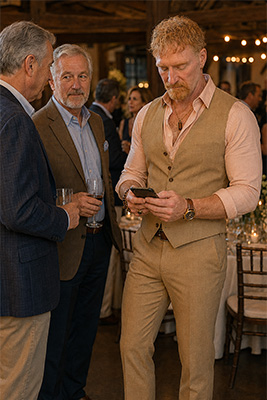
To appear completely approachable, leave your phone in the car. You can do it. It isn’t an umbilical cord.
◄ View ►
To appear completely approachable, leave your phone in the car. You can do it. It isn’t an umbilical cord.
If you don’t have the phone with you, you can’t keep looking at it. Every time you check the screen, you appear more interested in the phone than in the people around you.
Whoever is calling or texting can almost certainly survive without a reply for a couple of hours while you attend a dinner, party, meeting, or other social occasion.
If you genuinely must carry it, silence it and put it somewhere out of sight. Don’t place it on the table as though you’re waiting for something more important to happen.
If you’re alone for a moment, allow yourself to be alone. Look at the room. Notice the surroundings. Get a drink. Examine a painting. Watch what’s happening around you.
A man who can stand comfortably without hiding behind a screen projects far more confidence than one frantically pretending to be busy.
Let People See You
 ◄ View ►
Looking at the floor closes you off from the room. Looking outward makes you part of it.
◄ View ►
Looking at the floor closes you off from the room. Looking outward makes you part of it.
Eye contact is one area I continually have to work on. I don’t naturally like looking directly at anyone, even when I’m talking to him. I’ve had this aversion to eye contact my entire life, and I still have to force myself to do it.
It’s a struggle, but it’s a struggle worth the effort.
When you don’t look at the person speaking to you, he may assume you aren’t paying attention or that you don’t consider him important. Whether you intend it or not, it can feel disrespectful and make him feel insignificant. After three minutes of that, he’ll suddenly spot someone across the room whom he simply must speak with.
Make natural eye contact, but don’t stare. Look at the person, briefly look away when it feels natural, and then return your attention to him. You’re showing interest, not conducting an interrogation.
If someone nearby looks at you, acknowledge him with a slight smile or nod. You don’t need to grin at everyone or work the room like a politician chasing votes. You’re simply letting people know that you see them and that you’re comfortable being seen.
You don’t need to start a conversation with everyone you see. We’ll deal with that in How to Start and Carry a Conversation. For now, your job is to appear present, approachable, and at ease.
You Don’t Need to Command the Room
Walking into a room with confidence doesn’t mean making the loudest entrance.
You don’t need an exaggerated voice, a booming laugh, enormous gestures, or a joke prepared for everyone within hearing distance. You don’t need to prove that you’re the most important, successful, attractive, or interesting man there.
In fact, trying too hard usually reveals the very insecurity you hoped to conceal.
Real presence is often quieter. It comes from appearing comfortable with yourself, treating other people as though they matter, and moving through the room without begging for attention.
You are the star of your own show, but everyone else is the star of his own show too. Understanding that distinction allows you to carry yourself confidently without becoming overbearing. We’ll explore that further in Confidence Without Arrogance.
Nervousness Doesn’t Disqualify You
You can feel nervous and still make a confident entrance. Confidence doesn’t require the complete absence of fear. It means you don’t allow nervousness to control everything that follows.
When you feel anxiety building, stop thinking about how everyone might be judging you. Most people are far too occupied with themselves to conduct a detailed inspection of you.
Give yourself one manageable task. Greet the host. Find your seat. Get a drink. Introduce yourself to one person. Once you take the first action, the room usually begins to feel smaller and more manageable.
People often wait to feel confident before acting. In reality, confidence frequently arrives because you acted.
Recover and Keep Moving
Sooner or later, something will go wrong. You may walk through the wrong door, forget someone’s name, stumble over a word, misjudge a step, or nearly trip. None of those things needs to ruin your entrance unless you decide to make it a catastrophe.
Correct the mistake, smile if appropriate, and continue.
Don’t apologize five times. Don’t announce how embarrassed you are. Don’t replay the moment for the next hour while assuming everyone else is doing the same.
A confident man isn’t a flawless man. He’s a man who can recover without falling apart.
Practice Where It Doesn’t Matter
Don’t save this for the most important event of the year.
Practice when you enter a restaurant, store, coffee gathering, appointment, or gym. Put away your phone, raise your head, walk with purpose, and take in the room before deciding where to go.
These ordinary entrances allow you to build the habit without much pressure. Eventually, you won’t need to run through a checklist. The posture, walk, eye contact, and sense of purpose will become part of you.
That’s when confidence stops looking like something you’re attempting and begins looking like something you possess.
Walk Your Red Carpet
 ◄ View ►
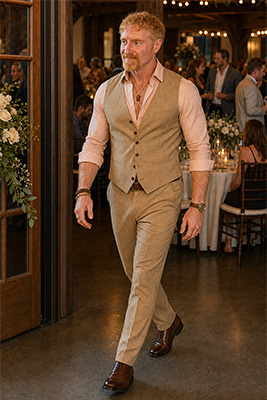
You don’t need to be the youngest, wealthiest, handsomest, best-dressed, or most important man in the room. You don’t need anyone’s permission to occupy your space.
◄ View ►
You don’t need to be the youngest, wealthiest, handsomest, best-dressed, or most important man in the room. You don’t need anyone’s permission to occupy your space.
You prepared yourself. You chose to come. You have every right to be there.
Put away the phone. Lift your head. Remember the music. Walk with purpose and allow the room to see the man you’ve worked to become.
Every doorway begins a new scene.
So when you walk into that room, remember who you are. You are the star of your own show, walking on your very own red carpet.