
 There are days when life doesn’t hand you one problem. It backs a truck into your driveway and unloads the entire damn thing.
The bill you weren’t expecting arrives the same morning your car starts making a strange noise. Someone in the family needs help. Your work is piling up. You haven’t slept properly. The house needs attention, the telephone won’t stop ringing, and every person who contacts you seems to want something.
None of these problems may be impossible by itself. Together, they can make you feel as though there isn’t enough room inside your head for one more thought.
That doesn’t mean you’re weak, incapable, or falling apart. Your mental hands are simply full.
As I explained in Stress, Small Things Really Matter, stress doesn’t always arrive as one enormous crisis. Small aggravations accumulate. One inconvenience lands on top of another until the combined weight becomes more than you can comfortably carry.
The danger begins when you stop seeing separate problems and start seeing one enormous, shapeless disaster called my entire life.
At that point, you don’t know where to begin because everything appears connected, urgent, and equally impossible. You move from one task to another without completing anything. You stare at the same email three times. You walk into a room and forget why you went there. You become irritated by ordinary questions because your mind has no space left for another demand.
You don’t need to solve your entire life in one afternoon. You need to stop, create some room, and decide what deserves your attention first.
When Problems Start Piling Up
Overwhelm is usually an accumulation problem.
Unopened mail, unfinished work, appointments, household responsibilities, financial pressure, family concerns, poor sleep, neglected health, and twenty small tasks can begin shouting at the same volume.
The first step is recognizing that they aren’t all the same problem.
An overdue bill is one problem. A disagreement with your partner is another. Laundry is another. A medical appointment is another. The fact that they arrived close together doesn’t turn them into one inseparable catastrophe.
 Your physical condition can also make everything feel worse.
Hunger, dehydration, exhaustion, pain, eye strain, and poor sleep can take a manageable day and make it feel like the walls are closing in. When your body is depleted, patience disappears, concentration becomes difficult, and every inconvenience feels larger.
I was reminded of that recently. I became completely absorbed in working on DougC and forgot to drink enough water. I hadn’t eaten enough either, and the eye strain from staring at the screen was catching up with me. Before long, I felt nauseated, miserable, and close to having a panic attack.
At that moment, it would have been easy to believe something was terribly wrong or that the pressure of the launch had finally become too much. What I needed was water, food, rest, and time away from the screen. After taking care of those basics, I felt much better.
That doesn’t mean you should dismiss serious or unfamiliar physical symptoms as stress, dehydration, or exhaustion. If something feels medically concerning, seek appropriate care. The point is that you shouldn’t declare your entire life a catastrophe before checking whether your body is simply running on empty.
Before making any major decision, ask yourself whether you’ve eaten, had enough water, slept, taken necessary medication, moved your body, or stepped away from the screen.
Sometimes life isn’t collapsing. Sometimes you desperately need lunch.
Get Everything Out of Your Head
 When everything feels like too much, stop trying to remember all of it.
Get a piece of paper, open a simple document, or use the notes application on your telephone. Write down everything occupying space in your mind.
Don’t organize it yet. Don’t decide whether an item is important. Empty your head.
Write down the bill, appointment, telephone call, work assignment, household repair, groceries, unanswered message, family concern, prescription refill, return you need to make, and anything else that keeps circling back.
Your mind is useful for thinking. It isn’t always the best storage container.
When responsibilities remain inside your head, they interrupt one another. While you’re thinking about the bill, you remember the appointment. While considering the appointment, you remember the email. While opening the email, you remember that the car needs gasoline.
Nothing receives your full attention because everything is fighting to be remembered.
Once the list is visible, the problems become separate again. You can see that the world isn’t ending. You have twelve things requiring different amounts of attention.
Now sort them into four groups.
• Must be handled today
• Needs attention soon
• Can wait
• Does not belong to me
That final group may be the most revealing.
Some men are overwhelmed because they’re carrying responsibilities that belong to other capable adults. They’re solving a relative’s repeated financial problems, managing a coworker’s unfinished work, organizing everyone’s social plans, and cleaning up situations they didn’t create.
You may choose to help, but choice and ownership are different. Before accepting another burden, ask whether the problem is truly yours.
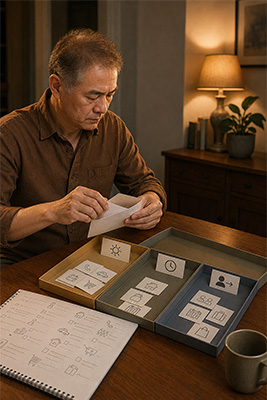 Once the list is sorted, choose the next action rather than trying to solve the entire problem.
Don’t solve your complete financial situation. Open the bill and determine what it says.
Don’t repair the entire relationship. Arrange a time for the necessary conversation.
Don’t finish the whole project. Complete the next section.
Don’t clean the entire house. Clear the kitchen counter.
The next action should be small enough to begin and meaningful enough to move something forward.
Progress restores control. Even one completed action tells your mind that you aren’t trapped. You’re moving.
Decide What Actually Matters Today
One reason everything feels overwhelming is that we begin treating every task as equally urgent.
A true emergency, an important responsibility, an irritating inconvenience, and something you merely hoped to accomplish today are not the same thing.
If everything receives emergency status, your mind never leaves emergency mode.
Suppose you have a medical appointment to schedule, a payment due, laundry waiting, a friend expecting a telephone call, a kitchen drawer you intended to organize, and a television program you wanted to watch.
Only some of those items have consequences if delayed. The drawer won’t file a complaint. The laundry can survive another evening. The television program will somehow continue without you.
Handle what protects your health, income, housing, safety, and important relationships first. Then work downward.
Be realistic about what one day can contain. A list containing sixteen hours of work doesn’t become an eight-hour list because you wrote it enthusiastically.
Move some items to another day. Reduce the scope of others. Remove anything that no longer matters.
A plan created under different circumstances isn’t a blood oath. You’re allowed to revise it when life changes.
You’re also allowed to renegotiate commitments.
If a deadline can be moved, ask. If someone else can handle part of the responsibility, delegate it. If an appointment can be rescheduled without causing harm, reschedule it. If an event no longer deserves your time, cancel it.
You don’t receive extra points for allowing every avoidable demand to remain on the same day.
Ask for help before you collapse. Strong men hire assistance, divide responsibilities, request extensions, and admit when a load has become too much for one person.
Waiting until everything falls apart doesn’t prove strength. It guarantees that every responsibility stops at once.
Stop More From Coming In
 You cannot empty a bucket while someone keeps pouring more into it.
When you’re already overloaded, temporarily close the door on new demands. Silence unnecessary notifications. Stop checking email every four minutes. Let nonessential calls go to voicemail. Decline additional favors. Stay off social media if it keeps adding agitation instead of relief.
The world doesn’t require immediate access to you every minute of the day.
Some men become overwhelmed because they spend the entire day responding. A message arrives, and they answer it. The telephone rings, and they pick it up. Someone asks for help, and they agree. An advertisement reminds them of something they should buy. A social-media post introduces another subject to worry about.
By evening, they’ve handled everyone else’s priorities and barely touched their own.
Create periods when nothing new is allowed into your attention. Finish what you’re doing before opening another door.
 This may mean placing the telephone in another room for thirty minutes. It may mean closing every browser tab except the one you need. It may mean telling someone, “I can’t discuss this right now, but I’ll call you tomorrow.”
That isn’t avoidance. It is controlling the flow long enough to regain your footing.
Be particularly careful about people who treat your availability as unlimited. If every conversation becomes another request, another emergency, or another problem you’re expected to solve, establish limits.
You cannot recover while remaining permanently available to everyone who knows your telephone number.
There are also times when you must stop adding pressure yourself.
You may be comparing your progress with someone else’s, setting impossible standards, or deciding that anything less than perfection represents failure. You may turn an ordinary delay into evidence that you’re hopelessly behind.
Good work doesn’t require constant panic.
There is a difference between urgency and frantic movement. Urgency identifies what matters and focuses on it. Frantic movement burns energy without direction.
Slow down enough to aim.
Recover Before Making Big Decisions
 When men become exhausted and overwhelmed, they often want to escape.
They quit jobs, end relationships, abandon projects, make expensive purchases, send angry messages, or decide that everything they’ve built was a mistake.
Sometimes a major change is necessary. But an exhausted mind isn’t always the best judge of what should be destroyed.
Don’t make a permanent decision during a temporary collapse.
Stabilize first. Eat. Hydrate. Sleep. Step away from the screen. Take a walk if you’re able. Spend a little time somewhere quiet. Allow your body and your temper to settle before deciding what the rest of your life should look like.
Recovery isn’t a reward reserved for the moment every task is finished.
If your responsibilities never completely end, that rule guarantees you’ll never rest. You’ll continue pushing until your body or mind forces the issue, usually at the least convenient possible time.
Rest is part of the work because it restores the ability required to continue.
You may not need an entire vacation. You may need an hour without demands, a decent meal, a full night of sleep, or one evening when you stop trying to fix everything.
After recovering, return to the list. The problems may still be there, but they’ll often look different when you aren’t viewing them through exhaustion.
There is also a point where ordinary stress becomes more than you should handle alone.
If the pressure continues for an extended period, prevents you from functioning normally, regularly causes panic, or leaves you feeling hopeless, speak with a qualified professional. Asking for help isn’t failure. It is another way of taking control.
If you believe you may harm yourself or someone else, seek immediate assistance. That is no longer a scheduling problem, and it shouldn’t wait until tomorrow.
Most difficult periods eventually become manageable when you stop treating them as one enormous object. Separate the problems. Take care of your body. Write everything down. Decide what matters today. Prevent more demands from flooding in. Ask for help where help is available.
Then handle the next thing.
 Everything doesn’t need to be carried simultaneously. Some responsibilities belong to tomorrow. Some belong to other people. Some no longer deserve to be carried at all.
When everything feels like too much, stop trying to carry everything at once.
Carry the next thing.