
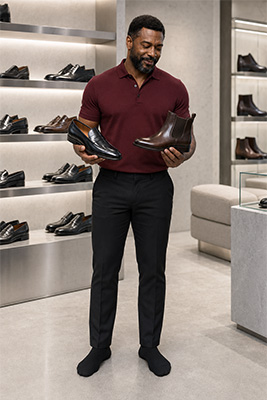
 Let’s finish the outfit by talking about the part that carries the entire man.
Footwear affects how you stand, walk, and feel, but it also influences how every piece of clothing above it is perceived. A beautiful shirt and perfectly fitted pants can lose much of their authority when they end in neglected, inappropriate, or thoroughly unattractive footwear.
Your shoes or boots don’t need to dominate the outfit. They should complete it. Their formality, shape, color, material, and condition should make sense with the pants, shirt, jacket, occasion, and man wearing them.
You don’t need dozens of pairs, nor do you need to follow every footwear trend that appears. You need enough variety to serve your actual life, and every pair should make you feel confident when you look down.
Begin With the Principal Types
 ◄ View ►
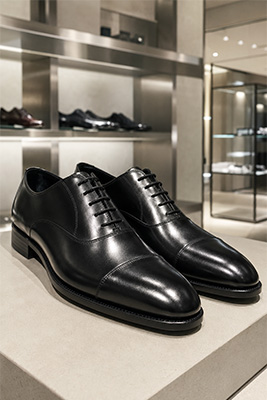
Men’s footwear falls into several broad families. Understanding their general character makes it easier to choose a pair without turning the subject into a graduate course in shoemaking.
◄ View ►
Men’s footwear falls into several broad families. Understanding their general character makes it easier to choose a pair without turning the subject into a graduate course in shoemaking.
Dress shoes are traditional lace-up or slip-on shoes with a clean, polished appearance. They work naturally with suits, dress trousers, and occasions requiring greater formality.
Loafers have no laces and slip onto the foot. They range from refined dress loafers to relaxed casual versions. A polished leather loafer can accompany dress trousers or a suit, while softer or more casual versions work with chinos and jeans.
Casual shoes include driving shoes, moccasin-inspired styles, boat shoes, and many other designs intended for relaxed settings. Their usefulness depends heavily on the material, construction, color, and condition.
Boots deserve equal consideration. Chelsea boots provide a clean shape with elastic side panels and can move between casual and dressier outfits. Chukka and desert boots are usually relaxed and work well with jeans and chinos. Dress boots can accompany suits and dress trousers. Western, harness, motorcycle, and work boots bring stronger character and require pants with enough leg opening to accommodate their shafts.
Each family can eventually support its own guide. For now, understand the general degree of formality and the role each one can play.
Let the Occasion Establish the Direction
Begin with where you’re going.
A business meeting, wedding, funeral, good restaurant, neighborhood gathering, afternoon of errands, and evening out don’t ask for the same footwear. The setting establishes the general level of formality, but it doesn’t automatically dictate one specific shoe.
A suit usually calls for polished dress shoes or appropriately refined dress boots. Dress trousers can work with dress shoes, loafers, or dress boots depending on the shirt and jacket. Chinos can move between loafers, casual lace-ups, Chelsea boots, chukkas, and other refined casual choices. Jeans can work with loafers, casual shoes, dressier lace-ups, or a wide range of boots.
Those are starting points, not prison sentences.
The condition and design of the footwear matter as much as its category. A sleek, polished boot may look more appropriate in a good restaurant than a neglected dress shoe whose best years ended during the previous administration.
Fit Begins With Your Feet
 ◄ View ►
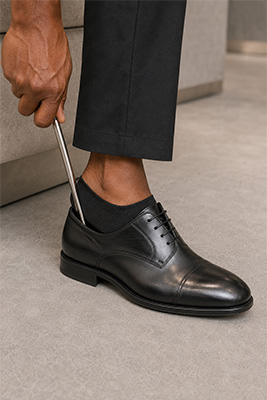
The size printed inside footwear is no more dependable than the number printed inside a pair of pants. Brands use different shapes, proportions, and sizing systems. Even two styles from the same company may not fit identically.
◄ View ►
The size printed inside footwear is no more dependable than the number printed inside a pair of pants. Brands use different shapes, proportions, and sizing systems. Even two styles from the same company may not fit identically.
Length is only one part of footwear fit. Width, toe-box shape, arch placement, heel shape, instep height, and overall volume all affect comfort.
Your toes need enough room to sit naturally without being compressed against one another or pushed into the front of the shoe. The widest part of your foot should align with the widest part of the footwear. Your heel should feel secure rather than lifting excessively with every step.
Pay attention to pressure across the instep and along the sides of the foot. A shoe can be technically long enough and still be completely wrong because its shape doesn’t match your foot.
Feet may differ slightly in size, so try on both shoes or boots and fit the larger foot. Your feet may also change over time because of weight changes, health conditions, activity, or the simple passage of years. Don’t assume the size you wore ten years ago remains correct merely because it is familiar.
If footwear sizes seem to change whenever you change brands or styles, read Now, Let’s Discuss Finding Your Size. The same lesson applies below the ankles: the number on the label is only a starting point.
Comfort and Style Can Coexist
Comfort matters because uncomfortable footwear changes the way you move. A man in pain may shorten his stride, shift his weight unnaturally, or spend the evening searching for a place to sit.
That doesn’t mean comfort requires surrendering to unattractive footwear.
Modern loafers, boots, casual shoes, and dress shoes can include cushioning, flexible construction, supportive footbeds, and lightweight materials. Some of the most comfortable footwear I own is also among the most stylish.
Judge comfort while standing and walking, not merely while sitting in front of a fitting-room mirror. Pay attention to support, balance, heel movement, pressure points, and how naturally your foot bends.
If a shoe feels fundamentally wrong, a handsome profile and famous label won’t make it a smart purchase.
Shape Changes the Impression
The shape of footwear affects the apparent proportions of both the foot and body.
A softly rounded toe generally creates a traditional and approachable appearance. An almond-shaped toe looks refined and can visually lengthen the foot without becoming severe. A modestly squared toe may appear strong and contemporary when handled carefully.
An excessively long or sharply pointed toe can make the foot look disproportionate and theatrical. A broad, heavy toe can add visual weight and may overwhelm narrow pants or a smaller frame.
The sole and heel matter as well. A thin leather sole usually appears more formal. A substantial rubber sole creates a heavier and more casual impression. A thick lug sole may make sense on a rugged boot but look clumsy beneath refined trousers.
Look at the entire silhouette from your shoulders to the floor. Footwear should provide an appropriate visual foundation rather than appearing detached from the man standing above it.
Coordinate Footwear With Your Pants
 ◄ View ►
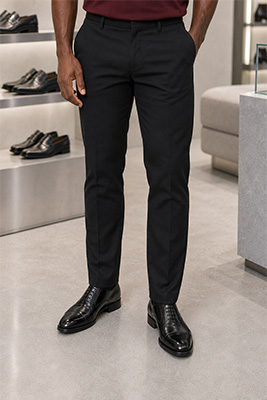
The relationship between pants and footwear is immediate. They meet physically, so neither can be evaluated properly without the other.
◄ View ►
The relationship between pants and footwear is immediate. They meet physically, so neither can be evaluated properly without the other.
Slim and tapered pants generally work best with footwear that has a relatively clean, controlled shape. Large, heavy shoes or boots beneath narrow pants can make the feet appear enormous.
Straight and wider legs can support footwear with greater visual weight. Bootcut pants widen below the knee so they can fall over a boot shaft without catching, bunching, or revealing its outline.
The length and break of the pants also change according to the footwear. Trousers hemmed for low-profile loafers may behave differently over ankle boots. Jeans intended for substantial boots may look too long or wide when worn with a sleek shoe.
Try the pants and footwear together. Don’t stand in a store wearing shorts, evaluate a pair of boots in isolation, and assume they will work with every pair of pants you own.
For a closer look at rise, leg shape, length, break, and how pants meet shoes and boots, continue with A Conversation About Pants.
Choose Useful Colors
Black footwear is traditional, authoritative, and especially useful with black, charcoal, and many formal outfits. It often provides the cleanest choice for evening events and more serious occasions.
Dark brown is remarkably versatile. It works with navy, gray, tan, brown, olive, burgundy, and many shades of denim. Medium and lighter browns generally appear more casual and attract greater attention.
Burgundy or oxblood footwear can add richness without becoming loud. It works particularly well with navy, charcoal, gray, tan, olive, and dark denim. The color is distinctive, but it remains masculine and sophisticated when the finish and shape are refined.
The belt and footwear don’t need to be manufactured from the same hide, but they should look related. Black shoes with a medium-brown belt usually create an unnecessary argument. Similar color families and compatible levels of formality produce a more intentional result.
Consider the rest of your collection before buying an unusual color. A spectacular pair that works with only one pair of pants may be less useful than a quieter pair you can wear several times each week.
Material Affects Character and Care
Smooth leather is traditional, versatile, and capable of becoming more attractive with proper care. Its finish can range from highly polished and formal to soft and casual.
Suede provides texture and a relaxed richness. It works beautifully in loafers, casual shoes, Chelsea boots, and chukkas, although it requires protection from moisture, dirt, and stains.
Patent leather has a highly reflective finish and belongs primarily with formal evening clothing. It can be appropriate with a tuxedo, but its usefulness outside those settings is limited.
Modern synthetic materials can offer flexibility, weather resistance, lighter weight, and easier care. Judge them by their appearance, comfort, performance, and value rather than dismissing or praising them solely because of their fiber content.
Read the material and care information before buying. A beautiful pair of suede shoes may not be practical if you regularly walk through rain, snow, mud, or road salt and have no intention of maintaining them.
For a broader discussion of natural materials, modern blends, comfort, durability, care, and value, read Now, Let’s Explore Fabrics.
Sneakers Have a Very Limited Place
 ◄ View ►
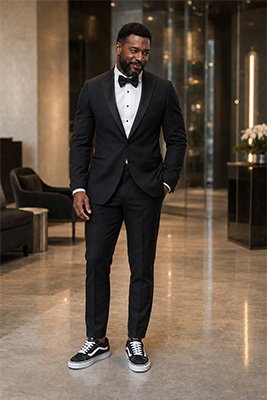
Let me be perfectly clear: I intensely dislike sneakers.
◄ View ►
Let me be perfectly clear: I intensely dislike sneakers.
As far as I’m concerned, once a man reaches 35, one pair of sneakers in his closet is enough. They have a legitimate place at sporting events, family reunions, and extremely casual settings, although very few suitable occasions immediately come to my mind.
Sneakers are not shoes in any meaningful style sense, and they never will be. I don’t find them attractive, distinguished, or particularly pleasant to look at. Their price doesn’t change my opinion. A $1,000 sneaker is still a sneaker, and an expensive version of unattractive footwear doesn’t suddenly become elegant.
Are they comfortable? Perhaps. But comfort is no longer exclusive to sneakers. Modern loafers, casual shoes, boots, and even many dress shoes can provide excellent cushioning, support, and all-day comfort while making a grown man look like a grown man. Sneakers frequently pull an otherwise respectable outfit toward adolescence.
That becomes particularly obvious when someone wears sneakers with a tuxedo on a red carpet. The intention may be to look rebellious, clever, or fashion-forward. To me, he simply looks foolish. I may give the outfit a casual glance and perhaps a chuckle, but it won’t earn my admiration.
You’re an adult. Wear footwear that strengthens your appearance, supports your confidence, and completes the man you worked to become. Don’t allow the easiest and most casual choice to diminish everything else you’ve put together.
A Little Extra Height
 ◄ View ►
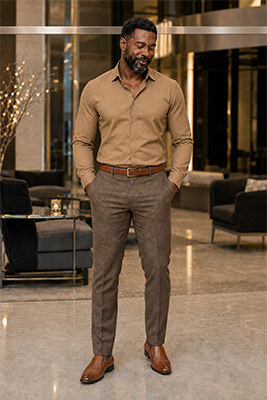
Elevated shoes are something I do endorse, and I wear them myself because I’ve always wished I were taller. The additional height is built discreetly into an otherwise stylish shoe or boot, so the footwear doesn’t need to announce what it is doing.
◄ View ►
Elevated shoes are something I do endorse, and I wear them myself because I’ve always wished I were taller. The additional height is built discreetly into an otherwise stylish shoe or boot, so the footwear doesn’t need to announce what it is doing.
An advertised three-inch lift may produce only about two inches of actual additional height once the shoe is on your foot. Even so, if you’re 5 feet 10 inches tall, those two inches suddenly carry you across that magical six-foot line everyone seems to find so impressive.
Mine are stylish, comfortable, and don’t look orthopedic or artificial. As with any footwear, the shape, construction, and fit matter. But if elevated shoes improve your proportions and give your confidence an extra lift along with your height, I see absolutely no reason not to wear them.
Examine the Construction
Turn the footwear over and look at it from every direction.
Check whether the upper meets the sole cleanly. Examine the stitching, edges, lining, heel, eyelets, buckles, elastic panels, zipper, and other hardware. Look for loose threads, exposed adhesive, uneven seams, scratches, color variation, or poorly finished edges.
The sole should suit the intended use. A polished leather sole may be appropriate for formal footwear, while a rubber sole can provide greater traction and weather resistance. Boots intended for rougher conditions need soles capable of supporting that purpose.
Price and brand recognition don’t guarantee excellent construction. Examine the pair in your hands rather than allowing a logo to complete the inspection for you.
Care For Your Footwear
 ◄ View ►
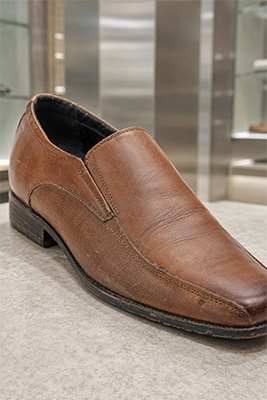
Footwear lives close to pavement, dirt, moisture, and everything else found on the ground. It needs regular attention.
◄ View ►
Footwear lives close to pavement, dirt, moisture, and everything else found on the ground. It needs regular attention.
Wipe away dust and surface dirt after wearing. Clean and condition smooth leather with products appropriate for its finish. Brush suede with the correct type of brush and treat it with a suitable protective product.
Allow damp footwear to dry naturally away from direct heat. Stuffing it gently with plain paper can help absorb moisture and preserve the shape, but avoid printed paper that may transfer ink.
Shoe trees can help leather shoes retain their shape, reduce creasing, and manage moisture. Rotating between pairs gives each one time to dry and recover before being worn again.
Inspect heels, soles, stitching, and hardware periodically. A small repair handled promptly can preserve a favorite pair. Waiting until the sole separates in public turns routine maintenance into live entertainment.
Shopping For Footwear
A physical store gives you the opportunity to compare sizes, widths, construction, and comfort before spending your money. Wear the type of socks you expect to use with the footwear, try on both shoes or boots, and walk around long enough to judge the toe room, heel movement, support, pressure points, and overall balance. Feet can differ slightly in size, so the pair must accommodate the larger foot without making the other one feel loose.
 ◄ View ►
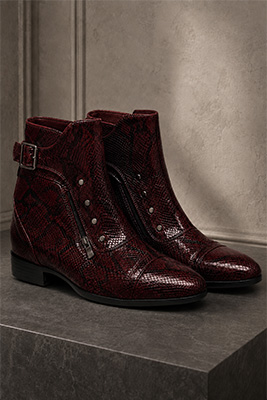
Online shopping makes sense once you understand how a particular brand and style fit your feet, but read the return policy before ordering. I once bought boots shown online in an unusual, very dark burgundy. That color was the reason I wanted them. When they arrived, they were a gaudy, fire-engine red that I wouldn’t have worn at any price. The seller offered me a 50 percent discount and later an even larger one, but a discount doesn’t correct the wrong product. Returning the boots to China at my expense would have cost approximately as much as the original purchase. That experience taught me to favor retailers offering free shipping and free prepaid returns, meaning the retailer provides the return label and pays the postage. Try footwear indoors as soon as it arrives, preserve every piece of packaging, and return it promptly in completely unworn condition if it isn’t right. If the policy expects you to pay international return postage, run away.
◄ View ►
Online shopping makes sense once you understand how a particular brand and style fit your feet, but read the return policy before ordering. I once bought boots shown online in an unusual, very dark burgundy. That color was the reason I wanted them. When they arrived, they were a gaudy, fire-engine red that I wouldn’t have worn at any price. The seller offered me a 50 percent discount and later an even larger one, but a discount doesn’t correct the wrong product. Returning the boots to China at my expense would have cost approximately as much as the original purchase. That experience taught me to favor retailers offering free shipping and free prepaid returns, meaning the retailer provides the return label and pays the postage. Try footwear indoors as soon as it arrives, preserve every piece of packaging, and return it promptly in completely unworn condition if it isn’t right. If the policy expects you to pay international return postage, run away.
Build a Collection That Serves Your Life
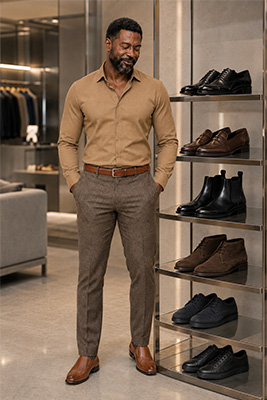 Don’t buy footwear for an imaginary schedule. Look at the places you actually go and the clothing you genuinely wear.
A man who regularly wears suits may need several pairs of dress shoes and refined boots. A man whose life is more casual may receive greater value from loafers, Chelsea boots, chukkas, and polished casual shoes.
Begin by identifying the occasions your current footwear cannot serve properly. Perhaps you need black dress shoes for serious occasions, dark-brown loafers for dinners and social events, or boots that work with your jeans and winter weather.
Once those needs are covered, add distinctive colors, textures, and designs that expand your choices rather than duplicating what you already own.
Every pair should earn its space through usefulness, comfort, appearance, or the confidence it gives you. The best footwear doesn’t merely protect your feet. It supports the way you stand, completes the way you dress, and strengthens the way you present yourself.
When the shirt, pants, and footwear work together, the outfit looks finished. More importantly, so do you.
Continue the Conversation
If you need help understanding how rise, leg shape, length, and break affect the relationship between your pants and footwear, continue with A Conversation About Pants.
If materials, comfort, care requirements, durability, and value are causing the greatest uncertainty, read Now, Let’s Explore Fabrics.